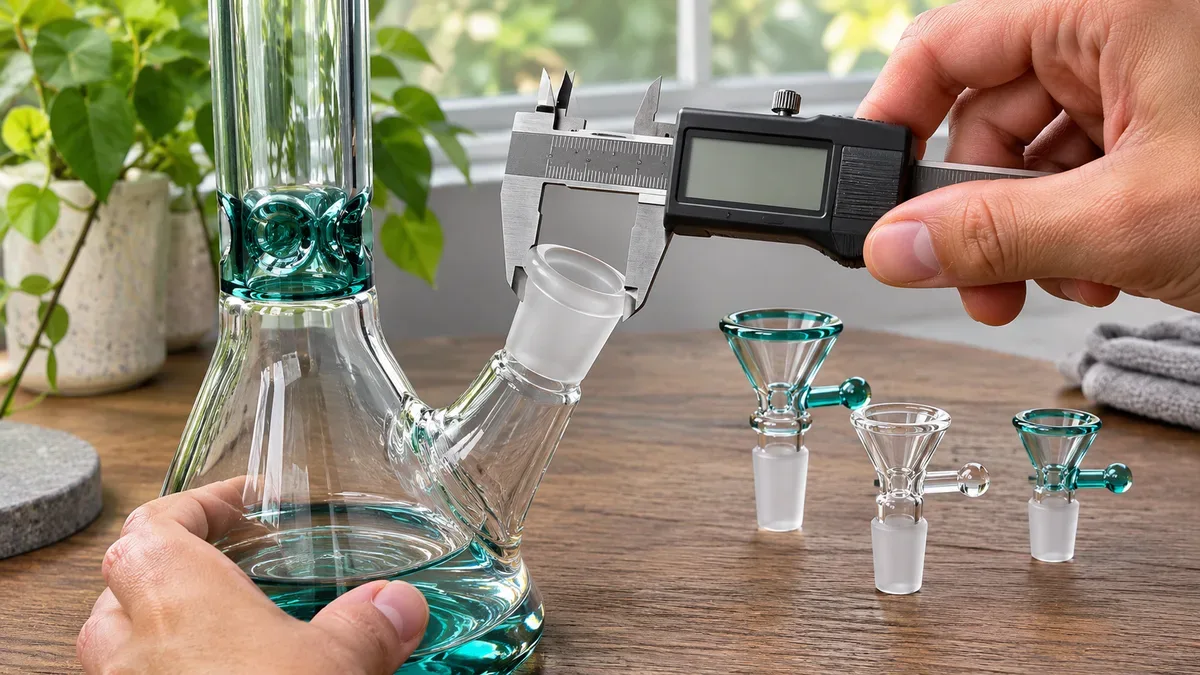
Have you bought a replacement cone piece that almost fits, but not quite? A difference of only a few millimetres can make a bong accessory unusable. Learning how to measure a cone piece joint diameter helps you avoid loose fittings, poor airflow and damaged glass. This guide explains how to measure male and female joints, identify 10mm, 14mm and 18mm fittings, and confirm the right replacement before ordering.
What Is a Cone Piece Joint Diameter?
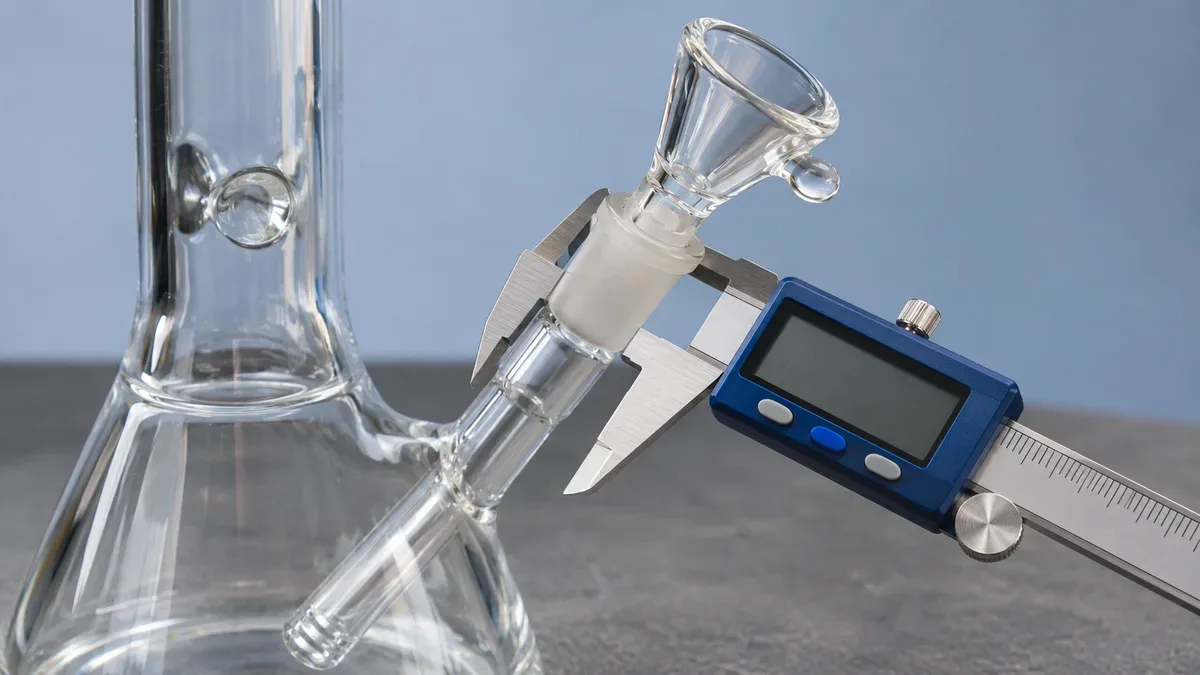
A cone piece joint diameter is the nominal width of the glass connection that joins the cone piece to the bong or downstem. Manufacturers normally state this measurement in millimetres. The most common sizes are 10mm, 14mm and 18mm.
However, the joint diameter does not describe the bowl’s overall width. It refers to the connection point that enters or receives another glass fitting. Therefore, a 14mm label usually describes the joint, not how much material the cone piece can hold.
Why Joint Diameter Matters
Accurate sizing affects airflow, stability and seal quality. A correctly matched joint creates a secure connection without excessive movement or unwanted air gaps. Additionally, the correct size helps keep the cone piece level during use.
A poor fit can create several problems. For example, a joint that is too small may not insert fully, while a loose fitting can wobble or leak air. Never force mismatched glass together because pressure can cause chips or cracks.
Joint Diameter Compared With Other Measurements
Several measurements can look similar, especially when you inspect a dirty or unusually shaped bong. Joint diameter, bowl diameter, downstem length and joint angle all describe different features.
- Joint diameter: The width of the glass connection, usually 10mm, 14mm or 18mm.
- Bowl diameter: The width of the cone or bowl area that holds material.
- Downstem length: The distance from the joint to the diffuser or submerged end.
- Joint angle: The direction of the connection, commonly 45 degrees or 90 degrees.
In contrast, bowl size cannot confirm joint size. A large bowl may use a 14mm joint, while a compact bowl may use an 18mm fitting. Always measure the connection itself.
Tools You Need Before Measuring a Bong Joint
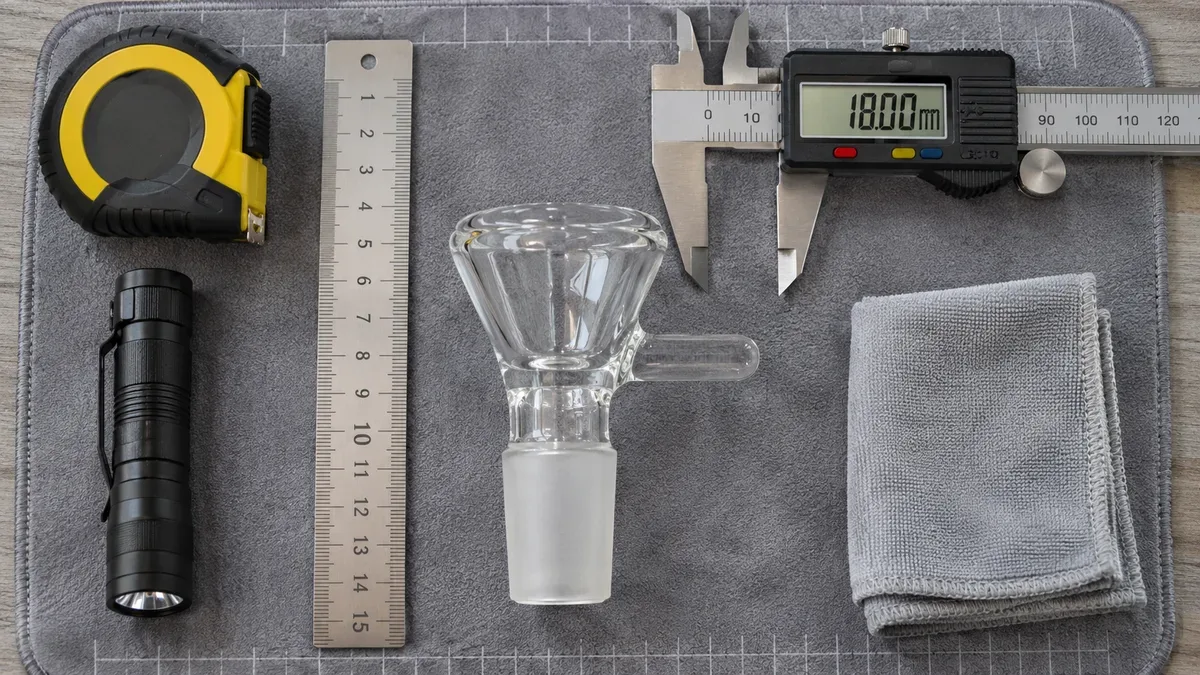
Digital calipers provide the most accurate way to measure glass bong joints. Choose a model that displays millimetres and has both inside and outside measuring jaws. Before measuring, close the jaws and press the zero button.
Calipers measure internal and external dimensions differently. The small upper jaws measure inside diameters, while the larger lower jaws measure outside diameters. This distinction is also explained in this digital caliper guide.
Meanwhile, a metric ruler offers a practical backup. Choose a ruler with clear millimetre markings and place it straight across the opening. A flexible measuring tape or paper strip can help with larger outer measurements, although these methods provide less precision.
Additionally, prepare a flashlight, microfiber cloth and phone camera. A flashlight can reveal residue or chips inside a dark socket. Your phone camera can capture the joint and help you inspect the rim from several angles.
Clean and fully dry the glass before measuring. Residue can reduce the opening, while moisture can make the caliper jaws slip. Always handle glass over a soft towel, avoid forcing parts apart and never measure hot glass.
How to Measure a Cone Piece Joint Diameter Step by Step
1. Identify the Joint Type
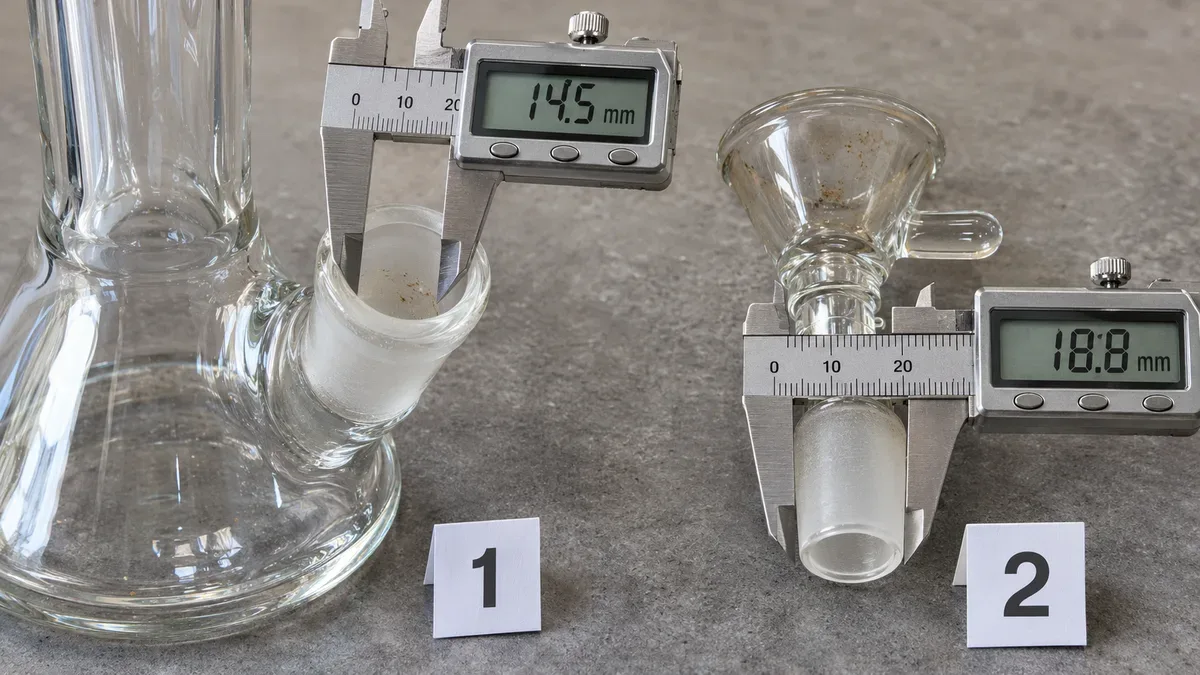
First, check whether the cone piece has a male stem or whether the bong has a female socket. A male cone piece has a glass stem that inserts into the bong. A female bong joint has an opening designed to receive that stem.
Some cone pieces connect through a separate downstem. Therefore, inspect both ends before measuring. You may need to measure the cone piece joint and the downstem joint separately.
2. Inspect the Glass
Next, examine the joint under bright light. Look for tapering, chips, thick glass, scratches, wear or sticky residue. These issues can affect the reading or prevent the accessory from seating correctly.
Furthermore, check whether the rim looks round. A slightly oval opening can produce different readings when measured across different directions.
3. Measure a Female Socket
Place the inside jaws of the digital calipers inside the female bong socket. Open the jaws gently until they touch opposite inner walls. Keep the jaws level and measure across the widest usable opening.
Do not push the jaws into the glass. Light contact is enough for a reading. Record the result in millimetres, then repeat the measurement at another angle.
4. Measure a Male Stem
For a male cone piece, use the outside jaws around the stem section that actually enters the bong. Keep the jaws square to the stem and avoid measuring the flared rim or tapered edge.
Measure near the working insertion area rather than the bowl body. The bowl may have a completely different diameter and can produce a misleading result.
5. Repeat the Measurement
Take readings at two or three angles around the joint. A consistent result suggests a round, usable fitting. However, noticeably different readings may indicate tapering, an oval shape, residue or damage.
For example, readings of 13.8mm, 14.0mm and 14.1mm usually point towards a nominal 14mm joint. Record both the readings and the condition of the glass.
6. Compare With Standard Sizes
Compare your result with standard nominal sizes instead of treating every decimal as a separate fitting. Most replacement cone pieces use recognised sizes, including 10mm, 14mm and 18mm.
| Approximate reading | Likely nominal size | Typical description |
|---|---|---|
| About 10mm | 10mm | Small joint for compact glass |
| About 14mm | 14mm | Common general-purpose fitting |
| About 18mm | 18mm | Larger fitting for bigger glass |
7. Check Other Dimensions
Finally, check the stem length, joint angle and downstem dimensions. Diameter alone cannot confirm compatibility. A correctly sized cone piece may still sit incorrectly if the angle or stem length does not match.
Small variations can occur because of thick glass, tapering and manufacturing tolerances. Therefore, confirm the nominal size with the seller before buying a replacement.
Should You Measure the Inside or Outside Diameter?
Measure the inside diameter when checking a female bong joint or socket. The measurement describes the space available for a male stem. Use the caliper’s small inside jaws, and keep them parallel with the opening.
Measure the outside diameter when checking a male cone piece stem or male downstem joint. The outside measurement describes the glass section that enters the female socket. Use the larger outside jaws for this task.
Measuring the wrong surface can produce a result several millimetres away from the correct size. For instance, measuring the outer rim of a female socket may include the glass wall. That reading will not represent the internal joint size.
Measuring an Attached Cone Piece
If the cone piece remains attached, do not twist or force it apart. First, clean the visible joint and inspect the connection with a flashlight. Then measure the exposed male stem or the accessible female opening.
When space is limited, place the caliper jaws carefully against the accessible edges. Keep the tool straight and avoid pushing sideways. If you cannot reach the joint safely, photograph it and ask the seller for guidance.
No-Caliper Measuring Methods
Without calipers, compare the opening against a metric ruler. Place the ruler across the centre of the opening and read the distance between opposite edges. Keep the ruler level for a better estimate.
You can also wrap a narrow paper strip around an outer stem. Mark the overlap, measure the strip, then divide the circumference by 3.14. This method remains approximate because small errors change the final result.
Additionally, compare the joint with a known 10mm, 14mm or 18mm fitting. Confirm the result through product specifications or the seller before ordering. A visual comparison alone should not decide an expensive glass purchase.
How to Tell If Your Bong Uses a 10mm, 14mm, or 18mm Joint
Ten-millimetre joints are smaller fittings often found on compact bongs and minimalist glass designs. They suit accessories with narrow stems and limited space. However, their smaller opening may not match larger replacement cone pieces.
Fourteen-millimetre joints are widely used for many cone pieces and bong bowls. They offer a common middle size and appear across many glass designs. Therefore, a measurement close to 14mm often indicates a standard 14mm fitting.
Eighteen-millimetre joints are larger fittings commonly found on bigger bongs. They can suit designs with larger openings and higher airflow requirements. Nevertheless, the joint must still match the accessory’s shape and angle.
Round a reading to the nearest standard size when the variation remains small. For example, 9.8mm usually indicates 10mm, while 17.9mm usually indicates 18mm. Do not round a reading that falls clearly between standard sizes.
A measurement between standard sizes may indicate a tapered joint, thick glass, residue, wear or a damaged rim. It may also mean you measured the bowl, outer rim or another incorrect surface.
A 14mm cone piece cannot directly fit an 18mm female bong joint. You may need a reducer or adapter that matches both connection types. Check whether the adapter has the correct male and female ends before ordering.
Male and Female Bong Joints, Angles, and Downstem Compatibility
A female bong joint is a socket designed to receive a male cone piece stem or male downstem. A male cone piece has a stem that inserts into that socket. Therefore, matching diameter alone does not guarantee compatibility.
Both parts cannot be male, and both parts cannot be female, unless an appropriate adapter connects them. Always confirm the connection type before comparing measurements.
Joint Angles
Joint angle describes the direction of the glass connection. A 45-degree joint points diagonally from the bong, while a 90-degree joint points straight out from the side.
However, the angle affects clearance and placement. A correctly sized cone piece may touch the bong, sit unevenly or obstruct another accessory if the angle differs.
Downstem Measurements
Measure downstem joint size separately from downstem length. The joint size describes the connection, while length determines how far the stem reaches inside the bong.
Additionally, check the inserted length, diffuser position and clearance from the bong’s base. A downstem that is too long may touch the bottom. A short stem may not reach the water correctly.
Tapered, unusually shaped, worn or thick-walled glass can create uncertain readings. If the joint has a chip or visible crack, replace the damaged glass. An unstable connection can worsen during handling.
Replacement Cone Piece Compatibility Checklist and Troubleshooting
Before ordering, work through the following checklist. Record each detail rather than relying on a product photo alone.
- Nominal joint size: 10mm, 14mm or 18mm.
- Connection type: male or female.
- Joint angle: 45 degrees, 90 degrees or another design.
- Stem length and insertion depth.
- Bowl or cone style.
- Downstem size, length and diffuser clearance.
- Glass condition, including chips, cracks and heavy wear.
Never force a 14mm cone piece into an 18mm socket. Likewise, avoid using a loose fitting that rocks or leaves a visible gap. Loose connections can cause air leaks, instability and stress around the glass rim.
Common Measurement Mistakes
- Measuring bowl diameter instead of joint diameter.
- Measuring the outer rim of a female socket.
- Ignoring tapering near the glass edge.
- Reading inches while assuming the display shows millimetres.
- Measuring residue instead of clean glass.
- Checking diameter but ignoring angle or stem length.
If your measurement does not match a standard size, clean the joint and measure again. Take readings in multiple directions, then inspect for chips, tapering or thick glass.
Furthermore, send the seller clear measurements and close-up photos. Include the joint orientation, bong model or original product link when requesting replacement advice.
Confirm the seller’s product specifications before buying. Also, check the return policy for glass accessories, especially when the original bong has an unusual design.
The final fit should feel secure, sit level and remain airtight. It should also show no visible stress, rocking or pressure around the glass connection.
Conclusion
To measure a cone piece joint diameter, measure the female socket from the inside or the male cone piece stem from the outside. Record the result in millimetres, then compare it with the nearest standard size.
Always verify the male or female configuration, joint angle, downstem dimensions and glass condition. Finally, measure your bong and cone piece using the checklist above, then confirm the specifications with the seller before purchasing.
Sweet Puff Australia brings together water pipes, glass designs and smoking accessories for adult customers. Explore the available collections and product information before choosing your replacement cone piece.