A sleeve that is only a few millimetres too tight can stress fragile glass. Meanwhile, a loose sleeve may let the pipe rattle into chips and cracks. Compact glass pipe protective sleeve sizing helps you measure the pipe, compare internal dimensions, and choose a safer fit. This guide explains fit allowance, protective materials, sizing examples, travel storage, cleaning, and buying checks.
1. Why Compact Glass Pipe Protective Sleeve Sizing Matters
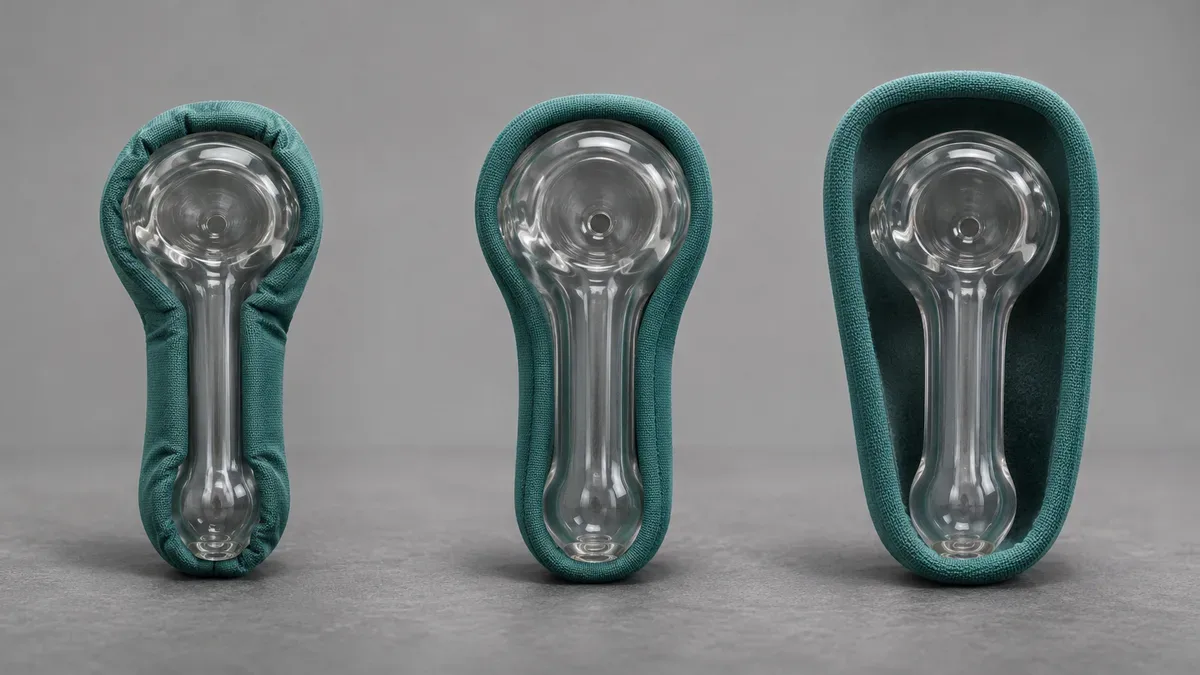
Accurate sizing helps reduce scratches, chips, cracks, and impact damage during storage or travel. Moreover, a well-fitted sleeve limits movement when the pipe sits inside a bag, drawer, or case. It also keeps fragile parts away from hard surfaces and loose accessories.
However, a protective sleeve cannot make damaged or structurally weak glass safe to use. Inspect the pipe first for hairline cracks, sharp chips, unstable joints, or other defects. Replace compromised glass instead of relying on extra padding.
An overly tight sleeve creates its own risks. Pressure may affect the bowl, stem, carb hole, decorative marbles, narrow connections, or flared sections. Therefore, never force a sleeve over a feature that catches during insertion.
On the other hand, an overly loose sleeve allows rattling and sliding. The pipe may strike the case wall, another accessory, or a hard surface. Loose storage can also provide poor odour containment, especially when the sleeve has no sealed closure.
This guide shows you how to measure a compact glass pipe, compare sleeve dimensions, and select suitable materials. You will also learn how to test the final fit before regular storage or travel.
Most importantly, install or remove a sleeve only when the pipe is completely cool, clean, and dry. Heat, moisture, residue, and grit can increase friction or damage the sleeve interior.
Protection starts with the glass itself
Choose sleeves as a storage aid, not as a substitute for careful handling. Additionally, keep fragile glass away from keys, metal tools, loose coins, and heavy objects. A simple measurement check can prevent an expensive replacement later.
2. How to Measure a Glass Pipe for a Protective Sleeve
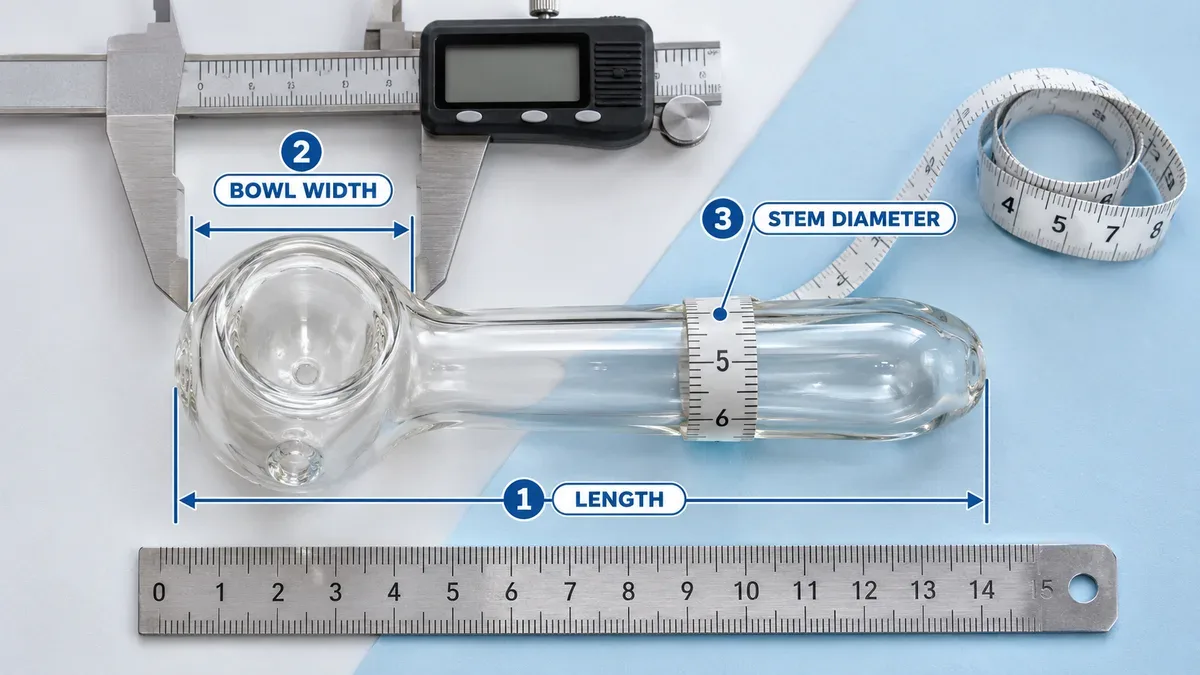
Tools and preparation
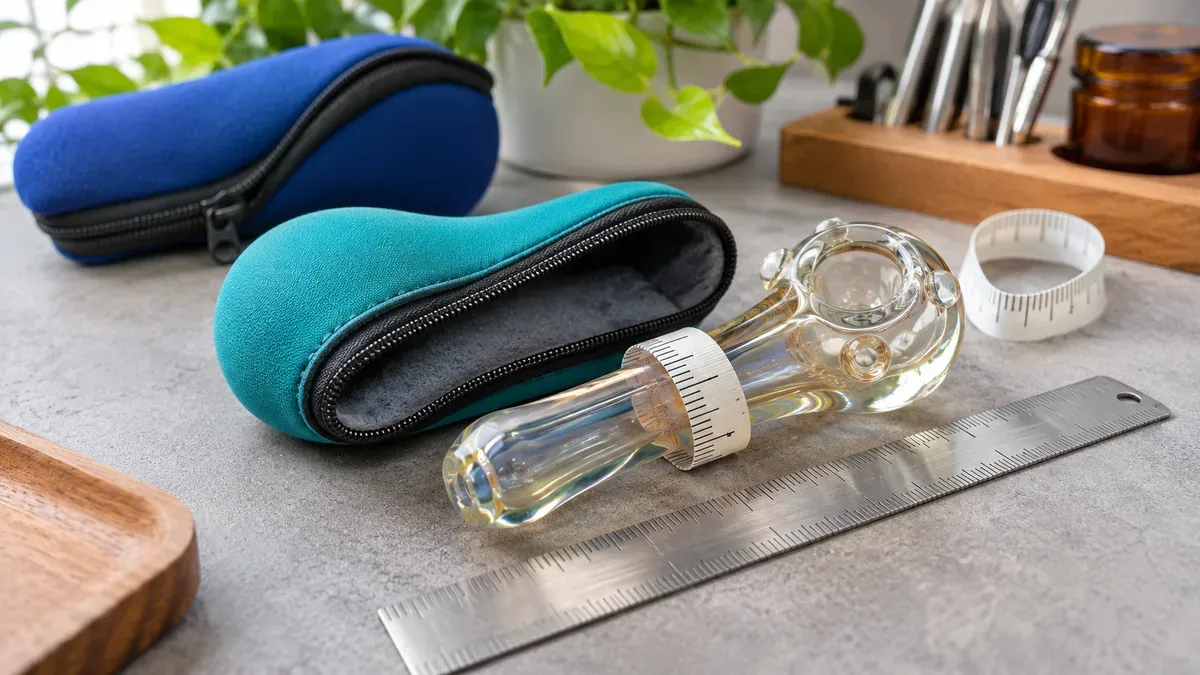
A ruler or measuring tape works for approximate measurements. However, digital calipers provide better accuracy for glass pipe diameter, bowl width, and stem thickness. Record every measurement in millimetres, because most sleeve specifications use metric dimensions.
Measure the pipe when it is cool, empty, clean, and fully dry. Remove removable accessories only when you will use the sleeve without those accessories. Otherwise, measure the complete setup that must fit inside the sleeve.
For glass terminology and material background, you can review this overview of borosilicate glass. Regardless of glass type, handle every measurement gently and avoid pressing calipers against thin sections.
The five essential measurements
First, measure total length from the furthest point of the mouthpiece or stem to the furthest point of the bowl or body. Use the longest practical axis, rather than following every curve.
Next, measure the widest diameter or width of the main body, bowl, and decorative features. Include anything that must fit inside the sleeve. A small marble or glass horn can control the final size.
Then, measure bowl width and bowl depth or height separately. This matters when the bowl is wider or taller than the pipe body. A sleeve may fit the stem while leaving too little room around the bowl.
Measure the narrowest and widest stem diameter at several points. Curved, tapered, flared, or carb-equipped stems often change size along their length. Record the maximum diameter for safe comparison.
Finally, describe the overall shape. Note whether the pipe is straight, curved, spoon-style, hammer-style, irregular, heavily decorated, or asymmetrical. Shape affects usable space more than length alone.
Numbered measuring method
- Prepare a safe surface. Place the pipe on a soft, non-slip surface. Avoid pressing down on the glass.
- Measure total length. For curved pipes, measure the sleeve-required length along the longest practical axis.
- Measure the widest points. Check the body and bowl from side to side.
- Check stem thickness. Measure several points and record the maximum diameter.
- Inspect protrusions. Note carb holes, glass feet, marbles, horns, sharp edges, and catching points.
- Save the record. Take a photo beside the ruler or save measurements in a product-sizing note.
Additionally, write down the measurement date and the sleeve style you are considering. This makes comparisons easier when different sellers describe products differently.
3. Compare Pipe Measurements With Sleeve Internal Dimensions
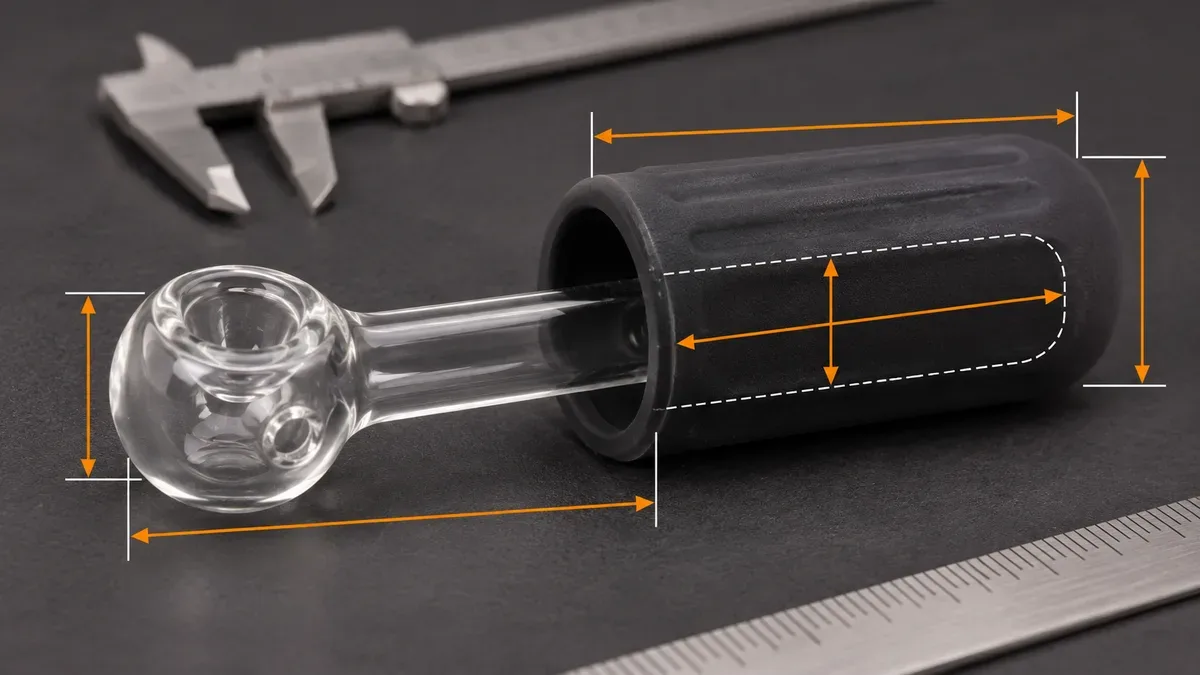
Sleeve listings can show several different dimensions. Internal dimensions describe the usable space inside. External dimensions describe the sleeve’s outside footprint, including walls, padding, seams, and closures.
Therefore, the pipe must fit within the sleeve’s internal length, width, and height. Do not compare your pipe against the sleeve’s external dimensions. Those figures may look generous while the actual opening remains narrow.
Check whether the manufacturer lists finished internal dimensions or only a nominal sleeve size. A nominal size may describe the product category, not the exact usable cavity. When details remain unclear, contact the seller before ordering.
For cylindrical sleeves, compare the pipe’s maximum diameter with the internal diameter. For rectangular cases, compare maximum width and height. Additionally, compare the complete length, including the bowl and any protruding decoration.
Closures, seams, tapered openings, end caps, elastic bands, and internal padding can reduce usable space. A sleeve may measure 100 millimetres externally but offer much less internal length.
Curved stems and wide bowls can also make a nominal length misleading. The pipe may fit through the opening but fail to sit fully inside. Moreover, a carb hole or decorative edge may create a pressure point.
Create a simple sizing comparison
| Measurement | Pipe measurement | Sleeve internal measurement | Available clearance |
|---|---|---|---|
| Total length | Record maximum | Record usable length | Sleeve length minus pipe length |
| Maximum width | Record widest point | Record usable width | Sleeve width minus pipe width |
| Maximum height | Record bowl or body height | Record usable height | Sleeve height minus pipe height |
| Stem diameter | Record largest point | Check opening size | Opening size minus stem diameter |
Should a sleeve match exact pipe dimensions? Usually, no. Exact matching can create a tight fit unless the sleeve is intentionally stretchable and approved for that variation.
Flexible silicone can accommodate modest changes. In contrast, rigid plastic and fitted hard-shell cases require more precise measurements. Always prioritise the tightest opening and the largest protruding feature.
4. Choose the Right Fit Allowance for a Glass Pipe Sleeve
A sleeve needs modest clearance. It should hold the pipe securely without compressing fragile glass. As a practical starting point, allow approximately 2 to 5 millimetres of total clearance for a flexible sleeve.
However, check the product’s specific stretch, padding, and opening design. Foam, neoprene, and padded storage may require more space because their material thickness reduces the usable interior.
Extra space does not always improve protection. Too much clearance permits movement inside the sleeve or case. As a result, the pipe may gain enough momentum to strike the surrounding walls.
Signs of a correct fit
- The pipe enters without force.
- The pipe remains centred during gentle movement.
- The sleeve does not create visible pressure points.
- The pipe does not rattle inside the storage space.
- You can remove the pipe without aggressive twisting or pulling.
Signs the sleeve is too tight
- Insertion feels difficult or uneven.
- Silicone shows whitening, distortion, or excessive stretching.
- Glass features appear compressed.
- The opening catches on a bowl, stem, or decoration.
- The closure will not shut naturally.
Signs the sleeve is too loose
- The pipe rattles during gentle movement.
- The pipe slides from side to side.
- Fragile sections remain exposed.
- The bowl shifts towards the case wall.
- The pipe contacts hard surfaces during transport.
If your pipe falls between two sizes, choose the larger size only when padding or secure retention prevents movement. Otherwise, select a flexible adjustable design.
One sleeve can fit multiple compact pipes only when their maximum dimensions, shapes, and protrusions fall within the usable range. Never assume similar lengths guarantee compatibility.
Do not trim or stretch a sleeve unless the manufacturer expressly permits it. Modifications can create thin spots, sharp edges, weak seams, or uneven protection.
5. Select a Sleeve Material and Design for Your Pipe
Silicone sleeves
Silicone sleeves are flexible, washable, and shock-absorbing. They suit simple or mildly irregular compact glass pipe shapes. Additionally, silicone may accommodate small variations without needing a rigid insert.
However, silicone should not stretch over sharp edges, fragile decorations, or oversized bowls. Heat resistance also varies by formulation. A heat-resistant label does not mean the sleeve is safe for a hot pipe.
Neoprene, foam, and fabric
Neoprene provides lightweight padding and flexible travel storage. It can suit straightforward shapes, but its seams and closure should not press against delicate glass.
Foam inserts absorb impact and allow shape customisation. However, foam may compress, retain odours, or shed particles over time. Inspect the insert regularly, especially when grit collects around the pipe.
Fabric sleeves are lightweight and discreet. Nevertheless, they offer limited protection unless they include padding or a structured lining. They work best for organised drawers and gentle everyday storage.
Rigid plastic and hard-shell cases
Rigid plastic and hard-shell cases provide stronger crush and impact protection. They require accurate internal dimensions and may need a fitted insert to prevent movement.
Consider hard-shell protection for checked luggage, crowded bags, or valuable collectible glass. In contrast, rigid cases can be bulkier and less convenient for compact everyday carry.
Also compare practical features before buying. Look at portability, odour control, discreet appearance, water resistance, closure quality, lockability, cleanability, and accessory compatibility.
For general storage, you can browse Sweet Puff Australia’s product categories or compare available accessories through the online shop.
6. Sizing Examples for Common Compact Glass Pipe Profiles
The following examples provide a practical starting point. They are illustrative only, so always confirm the manufacturer’s internal measurements before ordering.
| Pipe profile | Sample measurements | Suggested usable sleeve space | Preferred protection |
|---|---|---|---|
| Small straight hand pipe | 75 mm long, 22 mm maximum diameter | At least 80 mm long, 25–27 mm wide | Flexible silicone or padded fabric |
| Compact spoon pipe | 95 mm long, 32 mm bowl width | Confirm the widest internal dimension around the bowl | Shaped silicone or padded case |
| Short curved pipe | 85 mm longest axis, 25 mm body diameter | Flexible opening with room around the curve | Flexible sleeve with shaped opening |
| Decorated compact pipe | 100 mm long, 38 mm bowl width, glass marble | Measure the complete maximum envelope | Padded or hard-shell case |
The largest measurement controls fit, even when most of the pipe is much smaller. A broad bowl or marble can make an otherwise compact pipe unsuitable for a narrow tube.
Therefore, verify internal usable space, closure clearance, and compression around the bowl or stem. A sleeve that fits the body may still press against the widest feature.
7. Travel, Cleaning, Maintenance, and Safe Use
Compact glass pipe sleeves help organise drawers, display storage, and travel bags. They also separate glass from keys and other accessories. However, a sleeve alone may not provide enough protection in crowded luggage.
When carrying a sleeved pipe in a bag, place it inside a secure pouch or hard-shell travel case. Additionally, use a sealed, suitable storage container when odour control matters. Most sleeves reduce odour but are not fully odour-proof.
Never place a hot pipe into silicone, neoprene, foam, fabric, or a closed case. Allow the pipe to cool completely first. Heat-resistant labelling describes material tolerance, not permission to store hot glass.
Cleaning and inspection
For silicone, remove the pipe first. Wash the sleeve with mild dish soap and warm water, rinse thoroughly, and air-dry completely before reuse.
For neoprene, fabric, and foam, follow the care label. Avoid soaking materials that retain water. Meanwhile, inspect them for trapped residue, lingering odours, dampness, or compressed padding.
Check every sleeve regularly for tears, hardening, stretching, loose seams, damaged edges, trapped grit, or weakened closures. Replace it when the pipe no longer stays secure.
Replace the sleeve sooner when contamination cannot be removed. Keep the pipe and sleeve separate during cleaning. Never use a sleeve as a substitute for safe handling, cooling, or responsible storage.
Conclusion
Measure the pipe’s total length, maximum width, bowl dimensions, stem diameter, and complete shape. Then compare those figures with the sleeve’s internal usable dimensions. Allow modest clearance and choose materials suited to storage, travel, impact risk, and cleaning.
A correct sleeve holds the pipe securely without force, pressure, rattling, or exposed fragile features. Before buying, write down the maximum measurements and confirm the seller’s internal dimensions and material specifications.
Additionally, check customer reviews and return policies before committing to a size. For more storage ideas and accessory information, explore the Sweet Puff Australia blog.
Sweet Puff Australia brings together glass designs, water pipes, and practical accessories for informed shopping. Visit the Sweet Puff Australia website to explore available collections and product details.