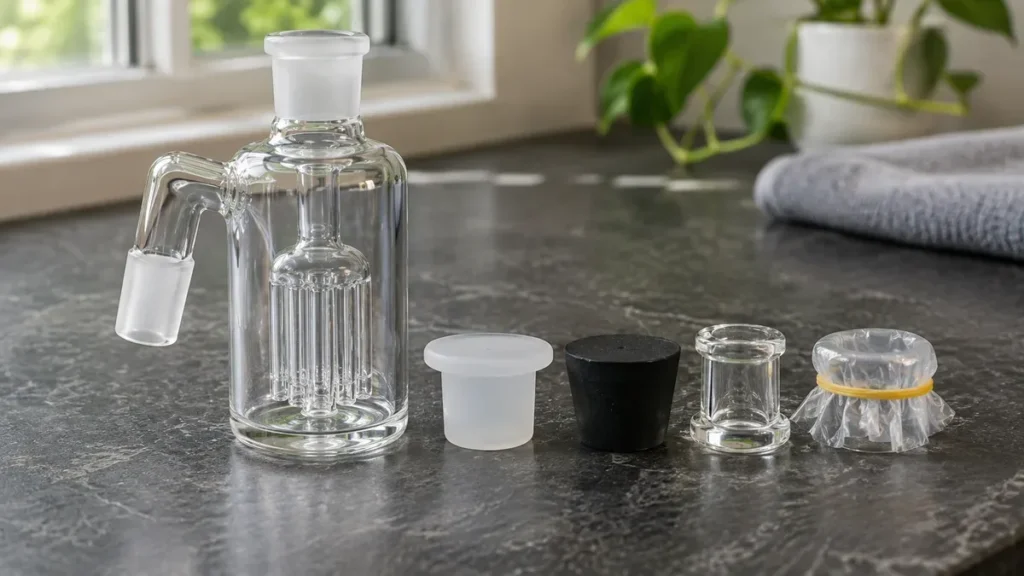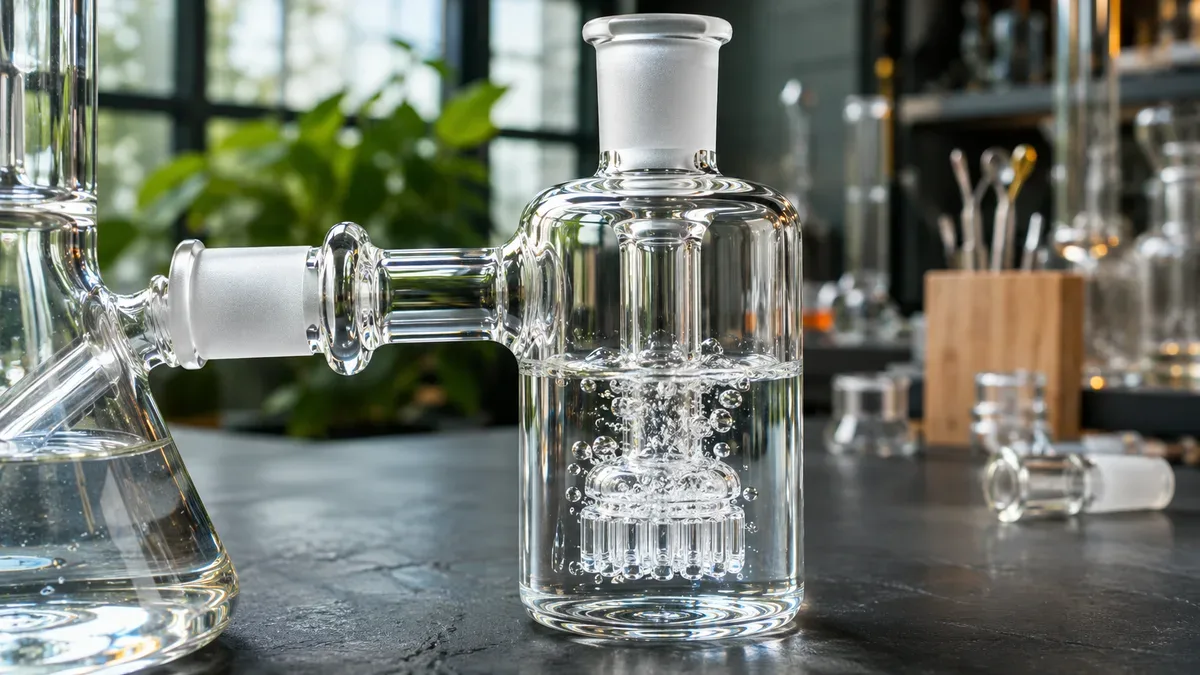
Why do two inline ash catchers with similar dimensions produce different airflow, bubble size and filtration? The answer usually lies in chamber geometry, diffuser placement, joint alignment and water depth. This inline ash catcher chamber design guide explains how those details affect performance, durability, cleaning and compatibility. It also covers responsible handling, heat management and practical checks before connecting any glass accessory.
Inline Ash Catcher Chamber Design: Purpose and Airflow Path
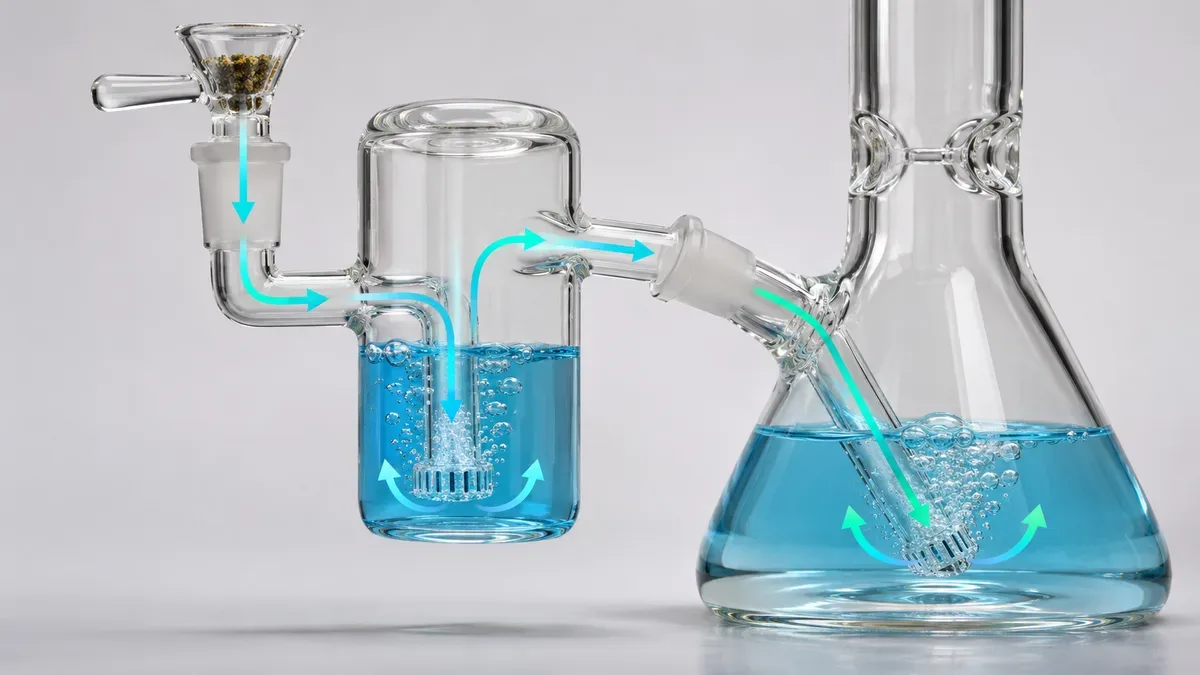
An inline ash catcher chamber sits between a glass water piece and its primary water chamber. It provides a secondary filtration stage before smoke reaches the main piece. This extra stage can collect ash, reclaim and resin while also cooling the smoke and reducing residue inside the larger chamber.
However, ash collection is not the same as complete filtration. A chamber may catch larger particles without removing every contaminant. Cooling depends on water contact, residence time and airflow speed, while reclaim collection depends on surface area and how quickly residue condenses.
Joint inlet
Inline diffuser
Water line
Chamber
Outlet
Primary
water piece
Airflow sequence and pressure balance
Air enters through the joint inlet and moves along the inline diffuser tube. The tube contains openings or slits that divide one stream into several smaller streams. Those streams enter the water, form bubbles and rise through the chamber before reaching the outlet.
Therefore, each transition affects pressure and drag. Narrow passages increase velocity and resistance, while larger openings allow easier airflow but may produce fewer, larger bubbles. Even slit spacing helps distribute air across the water-contact area instead of concentrating bubbles at one end.
Good chamber geometry balances filtration against usable airflow. Excessive diffusion can increase drag, encourage splashback and trap residue inside narrow openings. Conversely, too little diffusion may provide limited cooling and allow ash to pass directly into the primary water piece.
Handle glass components carefully during setup. Inspect for cracks, chips and stress marks, and avoid sudden temperature changes. A stable connection also reduces the chance of tipping, impact damage or strain around the joint.
Main Components of an Inline Perc Ash Catcher
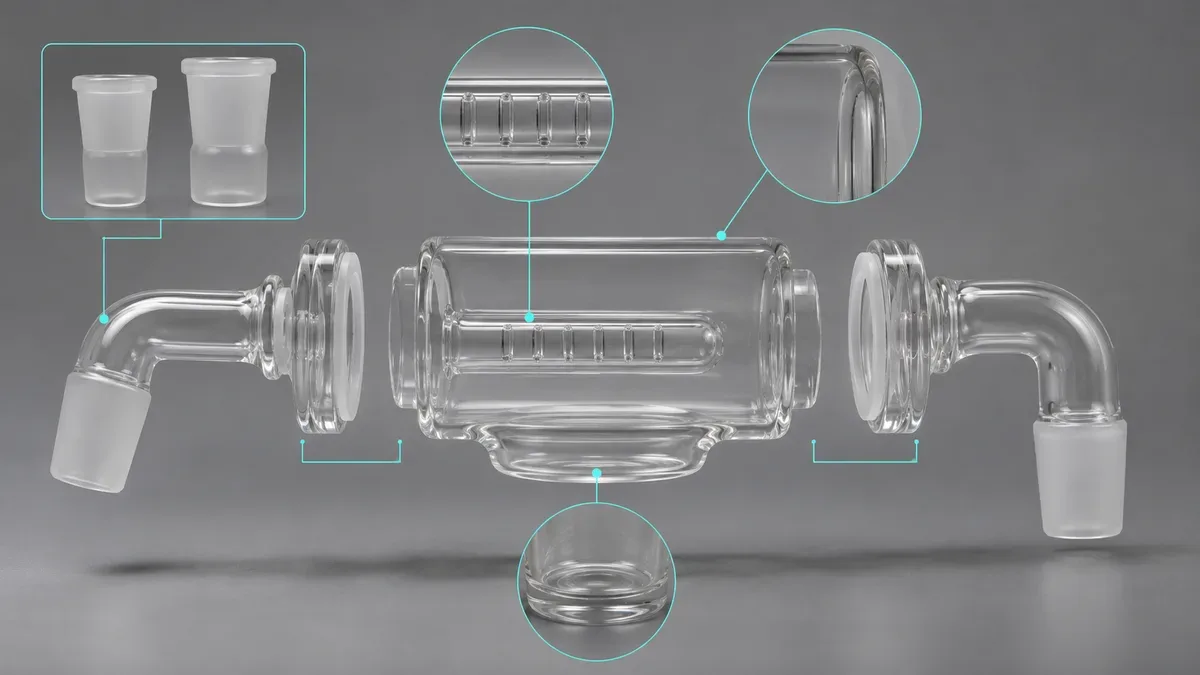
Joints, connectors and orientation
Most inline ash catchers use either a 14mm ash catcher or an 18mm ash catcher connection. The joint size must match the receiving joint, while the angle determines how the accessory sits against the water piece. A 90 degree glass ash catcher often provides a compact side-mounted layout, but it still needs adequate clearance around the base and neck.
Connector orientation affects balance and usable water depth. A joint that points too high may push the chamber into the neck. Meanwhile, a low or poorly angled connector can make the accessory unstable or place stress on the joint.
- 14mm connections: compact, lighter and common on smaller glass pieces.
- 18mm connections: wider, often suited to larger pieces and higher-volume airflow paths.
- 90 degree layouts: useful for side clearance, provided the chamber remains level and balanced.
Inline diffuser geometry
The diffuser tube controls how air enters the water. Slit width, slit length and slit placement influence bubble size, draw resistance and clogging behaviour. Slits positioned evenly along the tube usually create more consistent bubbling than openings grouped near one end.
How many diffusion slits should an inline ash catcher have? There is no universal number. Fewer, wider slits generally favour open airflow and easier cleaning, while more numerous narrow slits can increase bubble production and filtration.
However, narrow slits clog faster when ash, reclaim or mineral deposits accumulate. Designers should consider the intended draw, chamber volume, water depth and cleaning access together. The best result comes from a balanced opening area rather than the highest possible slit count.
Chamber structure and filtration styles
Chamber volume determines how long smoke remains near water and how much movement the bubbles can create. Chamber height, outlet position and mouthpiece connection also affect splash control. A stable base, reinforced joint and accessible opening can make the accessory safer and easier to maintain.
Inline percolation spreads airflow horizontally through a tube before bubbles rise. A traditional downstem sends smoke downward through a submerged tube. Honeycomb designs use many small openings, tree percs use branching arms, and showerhead percs use a wider vertical outlet with openings around its base.
An inline perc ash catcher differs from a downstem ash catcher in several ways:
- The inline design usually distributes airflow along a horizontal diffuser.
- The downstem design directs smoke downwards through a submerged tube.
- Inline chambers often use a wider, lower profile.
- Downstem layouts may offer simpler access when the stem removes easily.
Heat-resistant borosilicate glass remains a common choice because it offers clarity, chemical resistance and comparatively low thermal expansion. Borosilicate glass properties include useful resistance to thermal shock and temperature fluctuations. Nevertheless, borosilicate glass can still break after impact or rapid uneven heating.
How Chamber Size, Shape, and Water Level Affect Performance
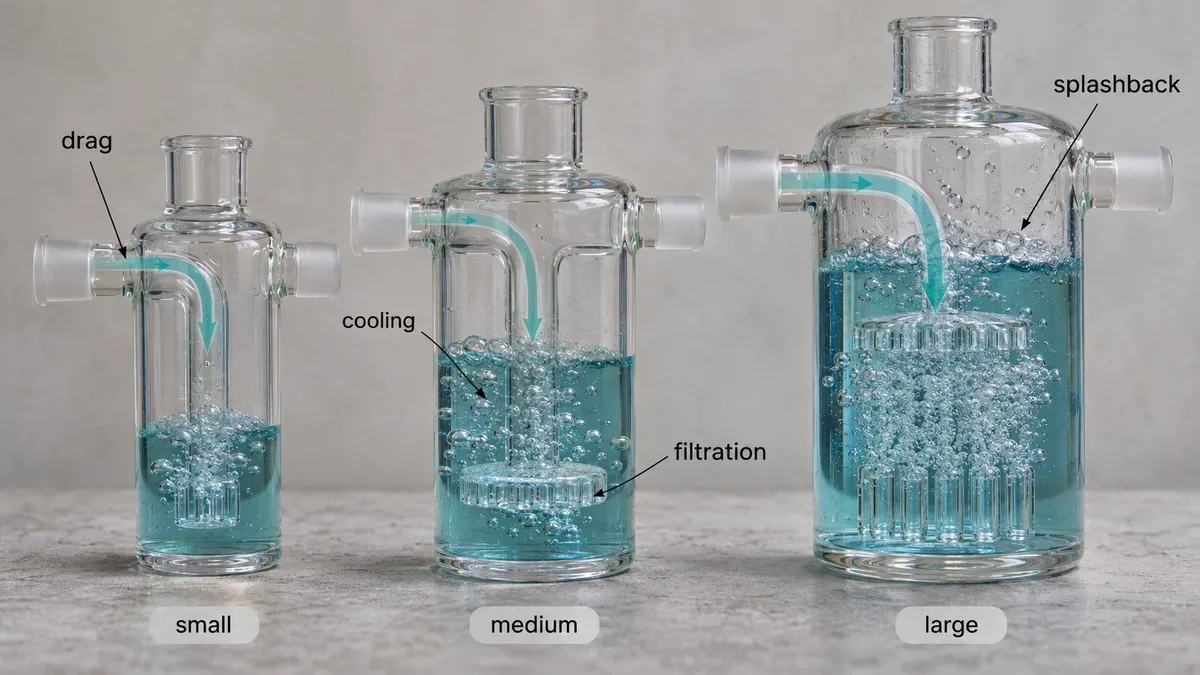
Chamber dimensions and airflow resistance
Diameter, height and internal volume influence how quickly air moves through the chamber. A narrow passage can increase resistance, especially when residue begins coating the walls. A wider chamber gives bubbles more room to expand and may reduce turbulence near the outlet.
For many designs, a rounded or cylindrical chamber offers a practical balance. It provides stable water coverage, predictable diffusion and fewer sharp internal corners. Additionally, smooth walls make residue easier to rinse away and reduce dead zones where reclaim can collect.
Larger chambers may improve cooling and increase smoke residence time. However, they require more water, add weight and can make a water piece feel top-heavy. Smaller chambers respond quickly and use less water, but they may create rapid water movement and greater splashback risk.
Water level and splashback control
Water should cover the diffuser openings sufficiently for bubbling. It should not submerge the outlet or restrict the exit path. The correct level depends on diffuser height, chamber diameter and the amount of movement created during a draw.
Excessive water is a common splashback cause. Other causes include short outlet clearance, fast draw speed, narrow chamber geometry and a diffuser positioned too close to the outlet. Splash guards, directional outlets and greater outlet height can help control droplets.
Diffusion-slit placement also matters. Openings spread evenly along the active water-contact zone can reduce uneven bubbling. Meanwhile, slits placed too close to the chamber wall may clog sooner and create localised flow.
Single and multiple-chamber configurations
A single chamber usually offers simpler airflow, lower weight and easier cleaning. A multiple-chamber design can add cooling and filtration stages, but it also adds drag, water requirements and manufacturing complexity.
Therefore, more chambers do not automatically mean better performance. Each additional stage creates another place for reclaim to collect and another section to inspect. Designers should justify the extra chamber through a clear filtration or cooling purpose.
Compatibility, Glass Thickness, and Structural Durability
Joint size affects both fit and airflow. A 14mm connection suits many compact water pieces, while an 18mm connection generally offers a wider passage and larger physical footprint. The accessory must match the receiving joint exactly, without forcing, rocking or placing sideways pressure on the glass.
Check insertion depth, joint angle and clearance around the main piece. The chamber should not touch a base, neck, downstem or decorative section. Additionally, the combined setup should remain balanced when filled with water.
90 degree glass ash catcher 14mm fit guide
- Confirm that both receiving and accessory joints use the 14mm format.
- Insert the joint gently and check that the seal sits evenly.
- Rotate the 90 degree chamber until the diffuser remains level.
- Check clearance around the base, neck and nearby glass features.
- Add the intended water volume and test stability before use.
Glass thickness affects durability, weight, heat handling and production cost. Consistent wall thickness helps distribute mechanical stress, while thin sections may become weak points near joints and narrow necks. Sharp transitions and unsupported connectors also deserve careful inspection.
Borosilicate glass suits many ash catcher applications, but material alone cannot compensate for poor construction. Evaluate symmetry, joint quality, weld consistency, chamber stability and inspection access. Custom buyers should also ask whether the design allows practical cleaning and safe storage.
- Everyday users: prioritise stable fit, moderate filtration and easy maintenance.
- Advanced users: may value adjustable airflow and controlled diffusion.
- Retailers: need clear sizing, orientation and care information.
- Collectors: may prioritise symmetry, craftsmanship and display value.
Before connection, inspect for cracks, chips, loose fittings, stress marks and unstable bases. If any defect appears near a joint or load-bearing transition, do not use the accessory until it receives proper assessment.
Design Problems, Clogging, Reclaim, and Maintenance
Common airflow mistakes include narrow passages, too many restrictive slits, uneven diffuser openings and sharp internal corners. Poorly aligned outlets can also create turbulence and force air through one side of the chamber. These problems often become more noticeable as residue builds up.
An inline ash catcher can clog through ash accumulation, resin, reclaim, hard-water deposits and narrow slit openings. Insufficient cleaning access makes the problem worse because residue remains inside hidden channels. A reclaim catcher focuses on collecting condensed residue, while an ash catcher primarily intercepts particulate material and cools the airflow.
Diffuser openings
Ash and reclaim zone
Chamber base
Residue and deposits
Outlet path
Inspect
Cleaning-friendly designs use wide openings, removable downstems, smooth surfaces and minimal dead zones. Start by emptying residue and rinsing promptly. Then use a suitable cleaning solution, brush reachable areas and rinse thoroughly before reuse.
Regular maintenance preserves airflow, bubble consistency, chamber capacity and joint performance. Water quality also matters, because mineral deposits can narrow openings over time. Dry the accessory fully, store it upright or securely supported, and inspect it frequently.
Inline Ash Catcher Design Evaluation Checklist and Recommendations
Artist and manufacturer checklist
- Check airflow resistance across the intended draw range.
- Confirm even diffusion across the full water-contact area.
- Test chamber volume, water-level range and outlet clearance.
- Inspect joint strength, wall thickness and transition quality.
- Confirm balance when the chamber contains water.
- Provide accessible openings for cleaning and inspection.
Retailer and consumer checklist
Retailers should label 14mm or 18mm sizing clearly and state the joint angle. Product information should explain orientation, water depth, stability, packaging protection and basic care. Customers should confirm fit, clearance, drag, bubble distribution, splashback control and reclaim management.
Beginners often benefit from a simple single-chamber design. It usually offers moderate filtration, stable fitting and lower maintenance effort. Advanced users may prefer more control over diffuser geometry, airflow tuning and bubble distribution.
Collectors and custom-glass buyers may place greater value on symmetry, unique chamber geometry, material quality and long-term display appeal. Even then, craftsmanship should include functional joints, stable construction and practical cleaning access.
Choose a design that balances filtration, airflow, durability, compatibility, cleaning and portability. Maximising diffusion alone can create unnecessary drag and maintenance. A single chamber suits compact setups and straightforward upkeep, while multiple chambers make sense when added cooling or staged filtration justifies the extra complexity.
For compatible accessories and glass designs, explore product categories at Sweet Puff Australia or browse the online glass accessory shop. Always compare the accessory with the dimensions and joint format of the water piece you already own.
Conclusion
Effective inline ash catcher chamber design depends on coordinated control of diffuser geometry, chamber size, water level, joint compatibility and glass thickness. Splashback prevention, reclaim management and cleaning access matter just as much as bubble production. The strongest design balances filtration with smooth airflow, durability, stability and practical maintenance.
Use the evaluation checklist to compare an existing ash catcher or guide a custom design. Before use, verify the joint size, angle, clearance, water level and chamber condition. Sweet Puff Australia brings together water pipes, glass designs and accessories for adults who want to compare practical options. Explore the Sweet Puff Australia website for more product information.