
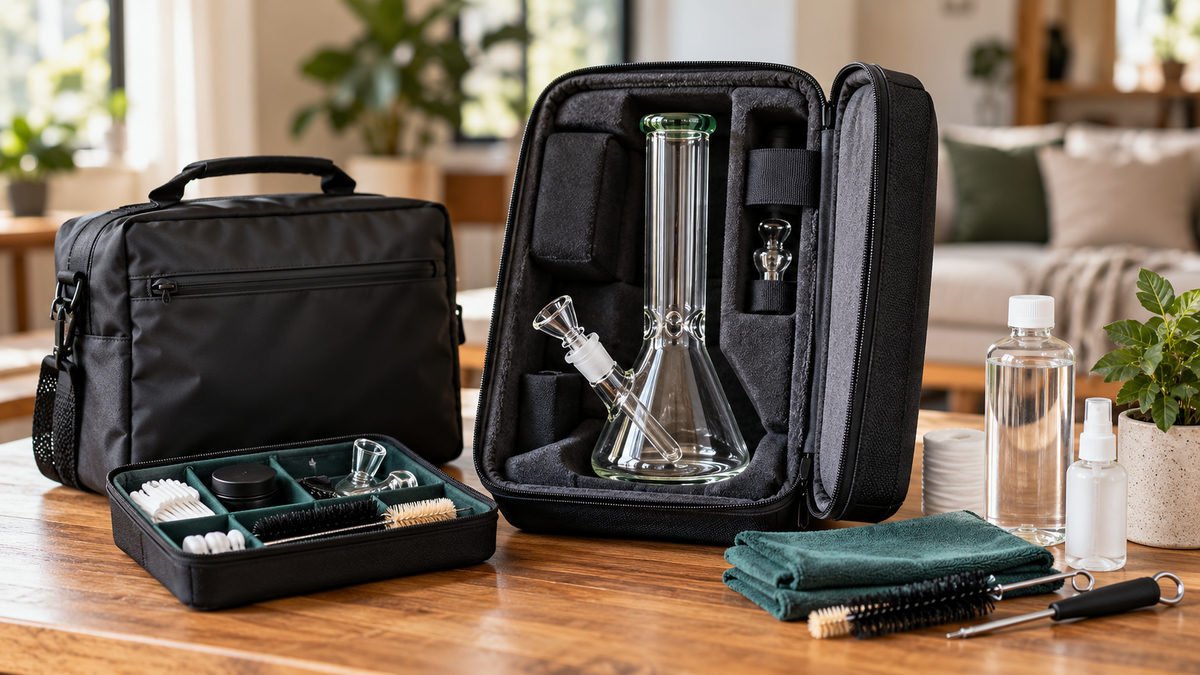
A single bump, dusty joint, or forgotten water residue can damage an expensive bong sooner than expected. This bong storage accessories guide helps you choose cases, bags, stands, cleaning supplies, and discreet storage solutions. You will learn how to protect fragile glass at home, during travel, in small apartments, and around children or pets.
1. Bong Storage Accessories Guide: Why Proper Storage Matters

Glass bongs need more than a safe-looking shelf. Accidental knocks, unstable surfaces, stacked items, and loose accessories can create chips or cracks. Therefore, suitable storage should support the bong, limit movement, and protect delicate joints. For the full routine, see how to store glass bongs safely.
Protection From Damage and Dust
A fitted case or stable bong stand reduces damage from tipping and accidental handling. Moreover, enclosed storage prevents dust from settling inside the chamber, bowl, downstem, and glass joints. Dust can mix with moisture and residue, creating a harder cleaning task later.
Leaving water inside the bong creates another problem. Over time, stagnant water can cause unpleasant odours, stains, mineral deposits, and sticky buildup. In fact, even a small amount of leftover water can make a storage area smell musty.
Choosing Your Main Storage Priorities
Store glass away from children, pets, heaters, direct sunlight, and busy walkways. Additionally, avoid placing a bong near the edge of a bench or beneath heavy objects. The Australian Competition and Consumer Commission recommends keeping potentially harmful household products secure and out of children’s reach.
For more household safety guidance, read the ACCC safe storage advice. Before buying accessories, consider five priorities:
- Portability: Decide whether the bong stays home or travels often.
- Protection: Choose padding, foam, or a crush-resistant shell.
- Discretion: Look for plain exteriors and odour-resistant materials.
- Capacity: Allow space for bowls, downstems, adapters, and tools.
- Budget: Match protection levels with the glassware’s replacement cost.
Should a bong stay stored with water? No. Empty it, rinse it thoroughly, and let every part dry completely. Then store the bong upright, covered, and separated from loose glass accessories.
2. Compare the Best Bong Storage Options
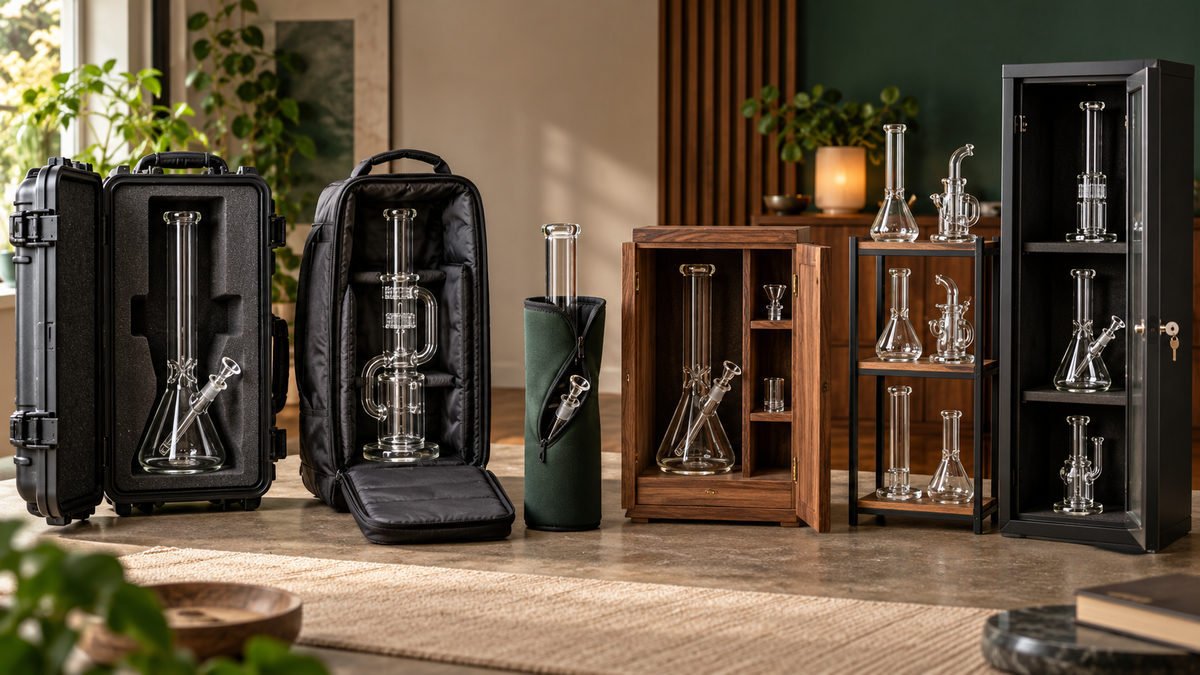
The best bong storage accessory depends on the glass shape, available space, and level of protection required. A compact sleeve may suit a short piece, while a tall recycler needs a fitted case. Meanwhile, a home cabinet may offer better organisation than a travel bag.
| Storage option | Best for | Main benefit |
|---|---|---|
| Hard case | Travel and maximum protection | Crush resistance and fitted foam |
| Padded bag | Regular carrying | Lightweight protection and compartments |
| Protective sleeve | Dust and short-distance movement | Simple, compact coverage |
| Storage box | Home organisation | Discreet storage and useful capacity |
| Stand or shelf | Frequent home use | Stable upright positioning |
| Cabinet | Shared homes and security | Enclosed, lockable storage |
Hard Bong Storage Cases
Hard cases provide the strongest defence against crushing, impact, and pressure. Many use rigid shells, custom foam, waterproof seals, and lockable closures. Therefore, they suit air travel, long-term storage, moving house, or expensive glassware.
Custom foam offers the most secure fit because it supports the bong’s base, neck, and wider sections. However, a hard case may cost more and take up additional cupboard space. Check the internal measurements carefully before buying.
Padded Carrying Cases and Travel Bags
Padded bong carrying cases offer lighter protection than hard cases. They often include handles, shoulder straps, adjustable dividers, and accessory pockets. Additionally, plain black or neutral exteriors can provide a more discreet appearance.
These bags work well for car trips, storage between uses, and regular carrying. However, they may not protect fragile glass from heavy pressure or sharp impacts. Choose thick padding and reinforced seams for better everyday protection.
Sleeves, Boxes, Stands, and Cabinets
Soft neoprene or padded bong sleeves help control dust and reduce minor scratches. They suit short-distance carrying, compact pieces, and storage inside a cupboard. However, sleeves cannot replace a rigid case when the bong faces serious impact risks.
Wooden, plastic, and fabric storage boxes provide practical home organisation. Wooden boxes can look discreet, plastic boxes resist moisture, and fabric boxes remain lightweight. Moreover, stands and shelves keep frequently used pieces upright without stacking glass.
Enclosed display cabinets offer dust protection and a more organised appearance. Lockable doors also help in shared homes, especially when children or pets may access low furniture. For a complete setup, modular organisers can hold a dab rig, bowls, downstems, adapters, dab tools, and cleaning products together.
- Best for home storage: A stable stand, enclosed box, or lockable cabinet.
- Best for travel: A fitted hard case with foam and separate compartments.
- Best for small apartments: A vertical cabinet or compact padded bag.
- Best for discreet storage: A plain, sealed case or concealed cabinet.
- Best for maximum impact protection: A crush-resistant case with custom foam.
3. How to Choose the Right Bong Case, Bag, or Organizer

Start by measuring the bong before comparing cases or bags. Record its total height, base width, widest point, neck shape, and downstem or joint clearance. Furthermore, measure removable parts separately because they may need individual compartments. Keep lighters separate too; see our lighter safety and storage tips.
The interior should provide enough room for padding without letting the bong shift. An oversized case allows movement, while a tight case can place pressure on the glass. Therefore, look for a secure fit around the base, neck, and widest section.
Compare Foam Inserts and Adjustable Dividers
Fitted foam inserts suit straight tubes, beaker bongs, and regularly shaped glass. They hold each piece in a fixed position and reduce movement during transport. However, custom foam may not suit unusual shapes or future accessories.
Adjustable dividers work better for recycler bongs, dab rigs, ash catchers, and mixed setups. You can create separate sections for the main piece, bowl, downstem, and tools. Additionally, soft divider walls should not press sharply against thin glass.
Check Protection, Odour Control, and Security
Look for shock-absorbing padding, crush-resistant shells, waterproof materials, reinforced seams, and secure zippers. A reliable case should also open smoothly without catching against the glass. Meanwhile, a sealed design can reduce dust and contain lingering odours.
Odour-control features may include gasketed closures, activated-carbon compartments, and odour-resistant liners. Separate accessory pockets also prevent resinous tools from touching clean glass. However, never seal a damp bong inside an odour-proof case.
For secure storage, consider lockable zippers, combination locks, hidden compartments, or a child-resistant cabinet. These features help prevent accidental access in shared homes. They also reduce the chance of loose components being handled or misplaced.
Protect Removable Glass Components
Bowls, downstems, ash catchers, adapters, and glass joints need individual protection. Use small padded pouches, silicone caps, joint covers, or dedicated foam cutouts. Therefore, never place loose glass parts together in one unlined pocket.
Can you use a regular case? Only when its dimensions, padding, closures, and internal organisation match the bong. A general camera or instrument case may work, but check every contact point first.
- Correct interior measurements and enough padding clearance.
- Stable support for the base, neck, and widest section.
- Separate compartments for bowls, downstems, and adapters.
- Water-resistant materials and secure closures.
- Discreet design and suitable odour control.
- Easy-to-clean lining and durable seams.
- Lockable features when household access matters.
- A reasonable price compared with replacement costs.
4. Essential Accessories for Cleaning and Preparing a Bong for Storage
Clean storage begins with the right preparation supplies. Useful items include bong cleaning brushes, pipe cleaners, isopropyl alcohol containers, coarse cleaning media, microfiber cloths, rinse bottles, and drying mats. Additionally, keep small trays nearby for removable parts.
Long cleaning brushes reach chambers, necks, percolators, downstems, and difficult interior surfaces. Narrow pipe cleaners help clear joints and small openings. Meanwhile, microfiber cloths remove moisture without leaving much lint behind.
Silicone plugs, joint caps, bowl caps, and dust covers help seal openings after cleaning. They reduce airborne dust and protect fragile connection points. However, only fit caps after the glass has dried fully.
Clean ash catchers, removable downstems, adapters, and bowls separately. Then store each part in a padded pouch or compartment tray. This approach reduces chips, trapped residue, and accidental contact between glass components.
Prepare the Bong Before Storage
- Empty all water from the bong.
- Rinse the chamber and detachable parts thoroughly.
- Remove the bowl, downstem, ash catcher, and adapters.
- Clean residue using suitable brushes and cleaning products.
- Rinse every part again until no cleaning residue remains.
- Air-dry the bong and accessories completely.
- Inspect each piece for cracks, chips, or loose joints.
- Fit dust covers and place each part into separate padding.
Storing equipment while damp can encourage odours, residue, mineral deposits, and microbial growth. Therefore, allow extra drying time around joints, percolators, and narrow tubes. A drying mat can keep parts upright while air circulates around them.
For long-term storage, complete a final clean and drying period before packing. Add silica gel only where appropriate, and keep it away from direct contact with glass openings. Furthermore, inspect the setup periodically for dust, moisture, odour, or developing damage.
5. Safe Bong Storage for Home, Travel, Small Apartments, and Shared Spaces
Home and Small-Apartment Storage
At home, use a stable bong stand, enclosed box, shelf organiser, or lockable cabinet. Place it away from edges, high-traffic areas, heat sources, and direct sunlight. Additionally, avoid stacking other items on top of the storage container. For longer trips, read our tips on packing glass bongs for moving.
Small apartments benefit from vertical cabinets, under-shelf organisers, compact sleeves, and multipurpose lockable containers. Choose stack-free storage that keeps the bong upright. Therefore, one well-fitted organiser often uses less space than several loose boxes.
Travel and Discreet Storage
Travel requires an appropriately sized hard case with fitted padding and separate compartments. Waterproof protection helps during unexpected rain or spills. Meanwhile, a discreet exterior avoids drawing attention to the contents.
Odour-proof bags, carbon-lined cases, sealed boxes, and concealed cabinets can improve discretion. However, complete drying remains essential before sealing. Ventilate the bong and storage area regularly if any odour remains.
Child- and Pet-Safe Storage
Use lockable containers, elevated cabinets, closed doors, and locations inaccessible to climbing pets or curious children. Keep cleaning products secured separately, especially alcohol-based products. Furthermore, small bowls, caps, and accessories should never remain loose on low shelves.
When transporting the bong, empty and dry it first. Remove detachable parts, wrap each piece separately, fill empty space with protective padding, and keep the case upright. Never transport a bong with water inside or loose glass parts sharing one compartment.
Prevent breakage by avoiding stacking, overpacking, poorly fitted cases, and extreme temperatures. Also, prevent unprotected contact between bowls, downstems, adapters, and the main body. A few minutes of careful packing can prevent costly damage.
6. Bong Storage Recommendations by Budget and Buying Priority
A practical budget setup does not need to include every accessory. Start with a reliable protective sleeve or padded bag, a basic bong stand, a microfiber cloth, and a cleaning brush. Add silicone caps and separate small pouches for removable parts. See every other upgrade in our bong accessories guide.
A mid-range setup can include a padded or semi-rigid carrying case with adjustable compartments. Look for an odour-resistant lining, accessory storage, reinforced seams, and stronger impact protection. This option suits regular carrying without the bulk of a hard case.
A premium setup includes a crush-resistant hard case with custom foam, waterproof sealing, lockable closures, and modular compartments. Pair it with a dedicated home cabinet or organiser for complete protection. Therefore, expensive or frequently travelled glass usually deserves stronger storage.
Decide how much to spend by comparing the bong’s value, travel frequency, replacement cost, household risks, and discretion requirements. For example, a simple sleeve may suit occasional home storage. In contrast, frequent travel may justify a fitted hard case.
- Choose a hard case for maximum impact protection.
- Choose a padded bag for portability and everyday carrying.
- Choose a sleeve for light protection and dust control.
- Choose a cabinet for home security and shared spaces.
- Choose a modular organiser for complete glass and tool setups.
Avoid common mistakes such as leaving water inside, storing pieces while damp, stacking glass, using oversized cases, and mixing loose accessories. Also, inspect the bong and storage equipment regularly. Your final checklist should include correct measurements, secure padding, separate compartments, odour control, a lockable closure, water resistance, easy cleaning, and a stable storage location.
Conclusion
The best bong storage solution depends on the glassware’s size and shape, travel frequency, impact risks, available space, odour concerns, household safety, and budget. Always empty, clean, and fully dry the bong before placing it inside a fitted case, sleeve, box, cabinet, or organiser.
Store detachable parts separately, protect every glass joint, and keep the complete setup away from children, pets, heat, and busy walkways. For more options, explore glass water pipes and related accessories or browse the Sweet Puff Australia shop.
Measure your bong, identify your top priority, and use the buyer’s checklist before choosing storage. Sweet Puff Australia brings together water pipes, glass designs, and accessories for adults comparing practical options. A well-planned setup keeps your glassware clean, organised, discreet, and ready for its next use.





