
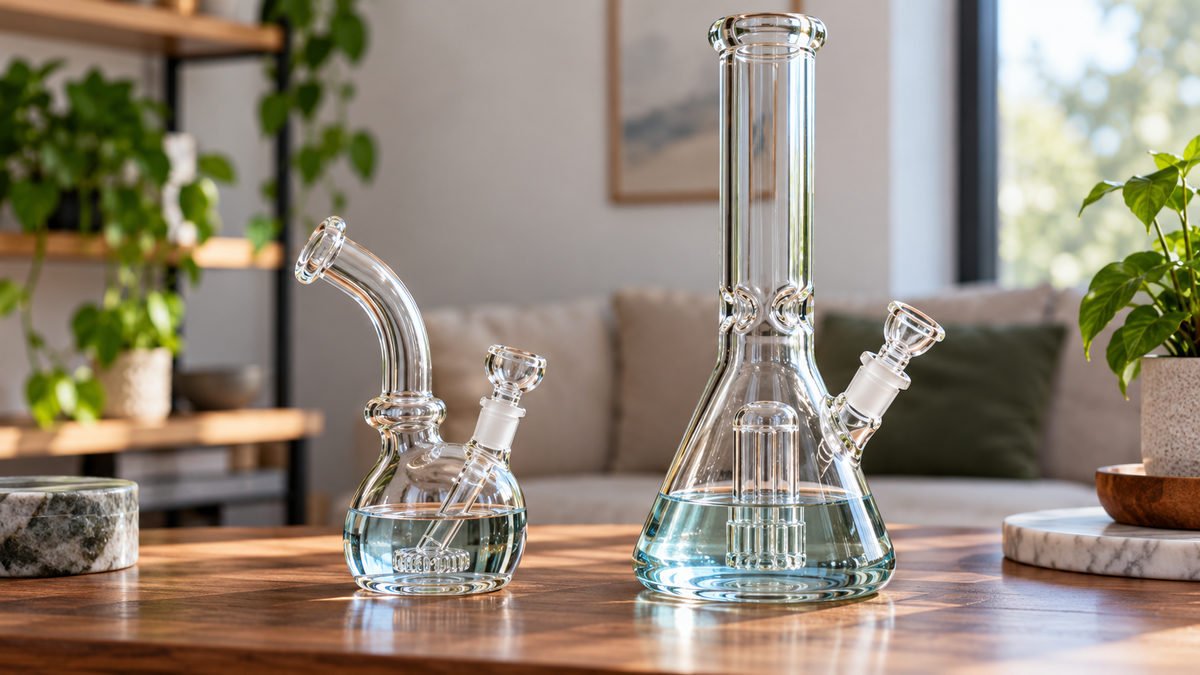
Choosing between a compact bubbler and a larger bong can change portability, cooling, filtration, and everyday convenience. Many buyers wonder about the bubbler vs bong differences, including whether a bubbler is simply a small bong. They also want to know which option feels smoother, lasts longer, and suits their space or experience. This guide compares both designs across performance, cleaning, price, durability, and practical use.
1. Bubbler vs Bong Differences: What Sets Them Apart?
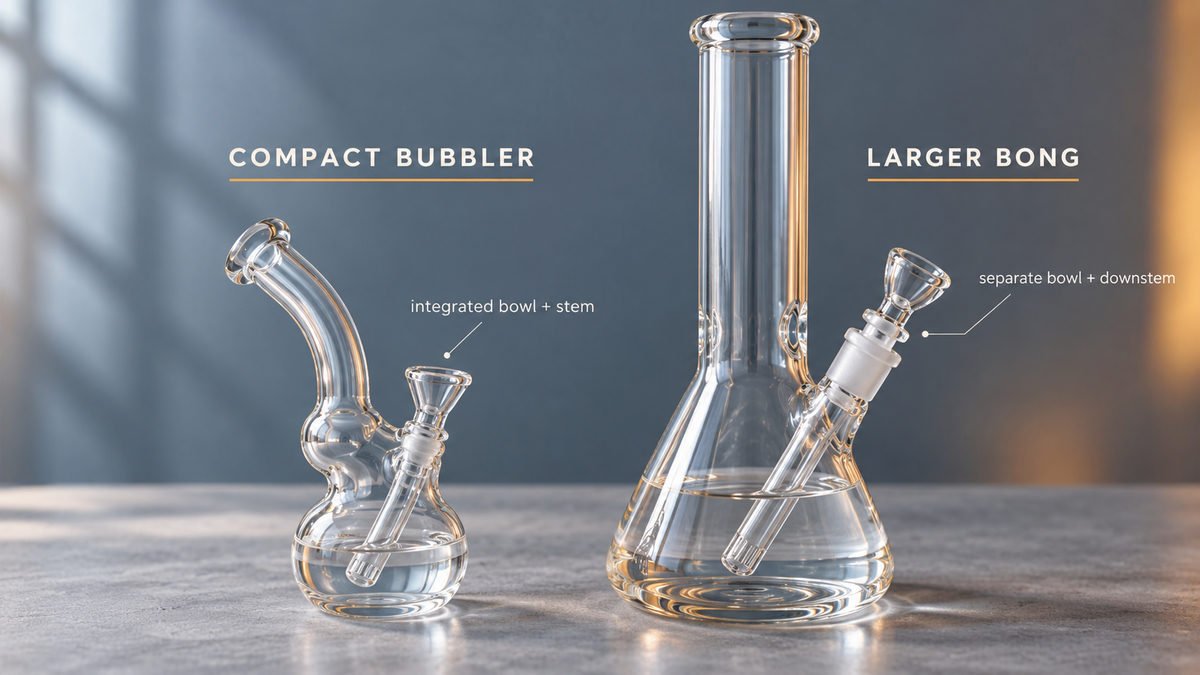
A bubbler is a compact water pipe with an integrated bowl, stem, and water chamber. Its smaller structure usually combines several parts into one handheld piece. Many bubblers also include a fixed mouthpiece and a built-in downstem or diffuser. New to bubblers? Start with our bubbler pipes guide.
By contrast, a bong generally uses a larger body with separate components. These often include a base, chamber, downstem, removable bowl, and mouthpiece. Some designs also add percolators, ice catchers, ash catchers, or adapters.
Both products use water filtration. However, they create different experiences because chamber size, airflow, water volume, and diffusion vary considerably. A bubbler often feels more compact and controlled, while a bong usually supports larger draws and longer filtration paths.
Construction and chamber design
Bubblers commonly feature a small chamber beneath or beside the bowl. Their mouthpiece may extend directly from the chamber, creating a short airflow path. Therefore, the user holds the whole piece like a traditional pipe.
Bongs usually stand upright on a broad base. The bowl sits to one side, while the downstem carries smoke into the water. The user then draws through a longer neck or tube above the chamber.
This difference affects stability. A bubbler takes little room on a desk or shelf, but its smaller base may feel less secure. Meanwhile, a bong typically offers more stability because of its wider footprint and heavier construction.
Is a bubbler simply a miniature bong?
Not exactly. Bubblers and bongs share water filtration, but their structures serve different priorities. A bubbler combines compact size and fewer removable parts, while a bong allows more space for filtration, cooling, and accessories.
For example, a bubbler may suit a buyer who wants simple storage and moderate filtration. A bong may suit someone who values a larger chamber, greater customisation, or a stable home setup.
When comparing the two, consider portability, filtration, cooling, hit size, maintenance, durability, price, and intended setting. Those factors matter more than the label alone.
2. Bubbler vs Bong Comparison Table
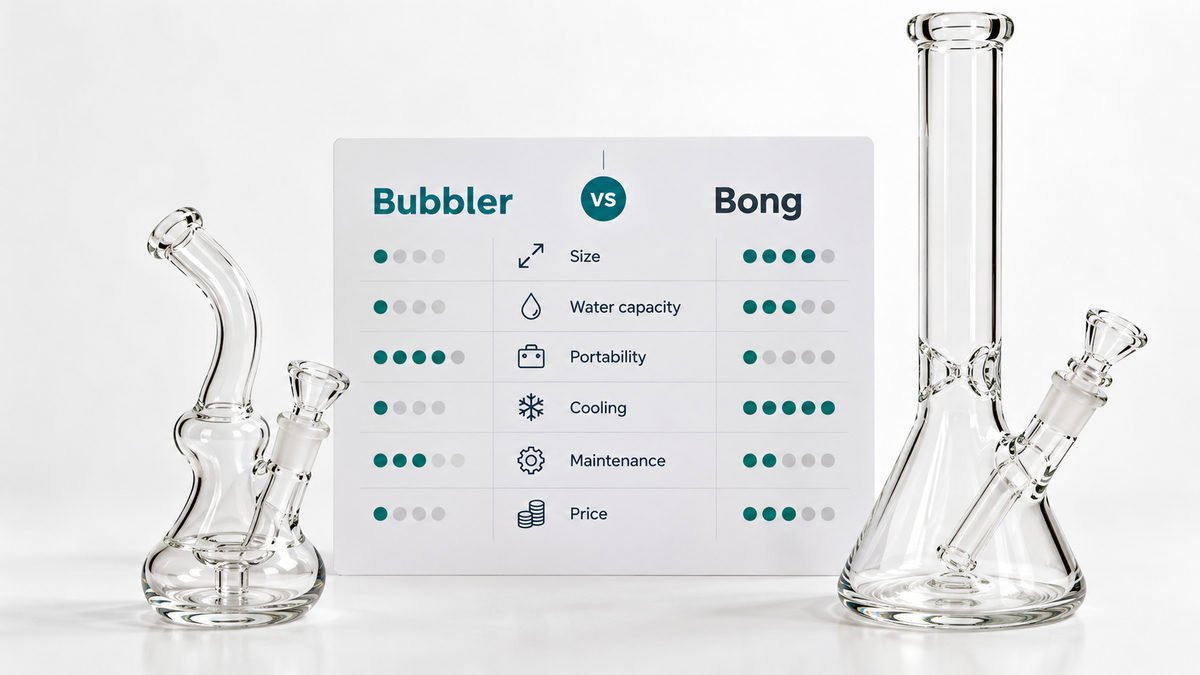
| Feature | Bubbler | Bong |
|---|---|---|
| Size | Compact and handheld | Usually taller and wider |
| Water capacity | Low to moderate | Moderate to high |
| Portability | Generally easier to carry | Better suited to stationary use |
| Stability | Depends on the base shape | Usually stronger due to a wider base |
| Filtration | Moderate, depending on diffusion | Can offer extensive filtration options |
| Cooling | Limited by the smaller chamber | Often stronger with more water and percolation |
| Smoothness | Controlled and moderate | Can feel smoother with advanced diffusion |
| Hit intensity | Often smaller and more measured | Can support larger draws |
| Airflow | Usually simpler and more restricted | Often more open and adjustable |
| Maintenance | Fewer parts, but small openings may challenge cleaning | More parts and water, especially with percolators |
| Price | Often lower, although premium models cost more | Broad range, from simple to highly engineered |
| Accessories | Usually limited by integrated construction | Often supports bowls, adapters, ash catchers, and downstems |
| Ideal use case | Compact storage, limited space, and simpler setups | Home use, larger draws, and customisation |
These differences provide a useful starting point, but performance varies between models. Glass thickness, chamber shape, percolator design, bowl size, and user technique can change the result.
For instance, a thick-glass bubbler may feel more dependable than a very thin bong. Likewise, a simple bong may offer less diffusion than a bubbler with a well-designed diffuser.
In general, choose a bubbler for compact storage and straightforward handling. Choose a bong when stability, larger hits, stronger cooling potential, or accessory support matters more.
3. Filtration, Cooling, Flavor, and Hit Experience

Water filtration works by pulling smoke through water before it reaches the mouthpiece. The water can catch some particles and reduce the heat of the airflow. However, filtration does not make smoke harmless or remove every unwanted compound.
For general background, the Wikipedia overview of bongs describes how water pipes use bubbling action during a draw. Additionally, Australian readers should remember that smoke exposure still carries risks, regardless of the device.
How bubbler filtration compares
A bubbler usually has a smaller chamber and shorter path between the bowl and mouthpiece. Therefore, the smoke has less room to spread and cool before reaching the user. The result may feel direct, concentrated, and easier to control.
Some bubblers include slits, holes, or small percolators. These features increase water contact and may create a smoother-feeling draw. However, the compact chamber limits how much diffusion the design can provide.
That does not make every bubbler harsh. A well-designed model with suitable water levels can provide comfortable filtration. Nevertheless, buyers should avoid assuming that smaller size automatically means weaker performance.
Why bongs can feel cooler
Bongs often provide more water, longer airflow paths, and additional diffusion chambers. These features give smoke more time to interact with water. As a result, many users experience a cooler and less concentrated draw.
Some bongs also include percolators or ice catchers. A percolator breaks smoke into smaller bubbles, while an ice catcher can support cooling through added ice. However, complex designs may increase drag, cleaning time, and breakage risk.
The largest chamber does not always create the smoothest experience. Poor water levels, blocked passages, or an unsuitable percolator can reduce airflow. Therefore, design quality and setup still matter.
Hit size, airflow, and flavour
A bong’s larger chamber can hold more smoke before a draw finishes. This capacity may support larger hits, especially with a larger bowl and open airflow. A bubbler usually encourages smaller draws because its chamber fills more quickly.
Meanwhile, bubblers can feel more approachable because their airflow often feels less dramatic. Some users prefer this controlled response when learning how to manage a water pipe.
Flavour also depends on the material, cleanliness, water freshness, and smoke temperature. Clean glass usually preserves flavour better than residue-covered surfaces. Additionally, excessive diffusion may soften some flavour notes along with the harshness.
Most importantly, a smoother-feeling hit does not mean the smoke is safe. Healthdirect Australia explains that cannabis use can involve serious risks, while smoking itself exposes the lungs to irritants. Always follow local laws and practise responsible adult use.
4. Portability, Ease of Use, Durability, and Beginner Comfort
A bubbler usually takes up less room than a bong. It can fit more easily in compact storage, a small cabinet, or a carefully padded travel case. Therefore, it may suit adults who have limited space or want a less prominent setup. If portability matters, also consider mini bongs.
Bongs generally need more room because of their height, base, and removable parts. They also suit a stationary setting better. Meanwhile, their wider bases often make them more stable during everyday use at home.
Which design feels easier for beginners?
A bubbler may feel simpler because it often has fewer separate parts. The bowl, stem, chamber, and mouthpiece form one compact unit. That reduces setup steps and makes the design easier to understand at first.
However, small openings can make water levels harder to judge. Some bubblers also have tight internal curves that require careful cleaning. A beginner should still learn how airflow, water height, and bowl loading affect performance.
A bong may offer more room to observe the chamber and water movement. Its larger shape can make airflow easier to understand. Nevertheless, the extra parts and larger draw potential may feel overwhelming for some first-time users.
Durability and material choices
Glass remains popular because it provides clean flavour and allows users to see the water and smoke path. Borosilicate glass can offer stronger heat resistance than ordinary glass. Even so, every glass piece can break when dropped or knocked against a hard surface.
Silicone models offer more flexibility and may handle transport better. However, silicone can retain odours and flavours more readily than clean glass. Some buyers therefore prefer silicone for travel and glass for home use.
Shape also affects durability. Thick walls, reinforced joints, wide bases, and fewer exposed parts can reduce everyday breakage risks. In contrast, tall necks, thin glass, and complex percolators need more careful handling.
- Store glass pieces on a stable, low surface.
- Keep them away from children, pets, heat sources, and busy walkways.
- Use a padded case when transporting a piece.
- Never use damaged glass with cracks, chips, or loose joints.
5. Cleaning, Maintenance, Accessories, and Cost
Both bubblers and bongs need regular water changes and residue removal. Fresh water helps keep the experience cleaner and reduces stale odours. Additionally, routine inspection can reveal blocked openings, loose parts, or damaged joints. Here is how to clean a bubbler pipe properly.
Cleaning a bubbler
A bubbler often uses less water and contains fewer removable parts. However, its compact interior can make residue difficult to reach. Small openings may also need a narrow brush or a suitable cleaning tool.
Start by emptying the old water and separating removable parts where possible. Rinse the piece with warm water, then use a purpose-made glass cleaner according to its instructions. Avoid sudden temperature changes, which can stress the glass.
Clean around the bowl, mouthpiece, stem, and internal diffuser. Finally, rinse thoroughly until no cleaning residue remains. Always handle the bubbler over a soft surface or sink to reduce breakage risk.
Cleaning a bong
Bongs can require more time because they hold more water and often include several components. Remove the bowl and downstem before cleaning. Then clean the chamber, neck, base, and any percolators separately when possible.
Complex bongs may include multiple percolators, reclaim-catching sections, or narrow internal passages. These features can improve diffusion, but they also create more places for residue to collect. Therefore, buyers should consider cleaning effort before choosing an advanced design.
Use appropriate cleaning supplies and follow the manufacturer’s guidance. Avoid unsafe modifications, harsh household chemicals, and tools that can scratch or crack the piece.
Accessories and price considerations
Bongs often support more accessories than bubblers. Depending on the design, these may include removable bowls, downstems, ash catchers, adapters, screens, cleaning brushes, and storage cases.
Compatibility depends on joint size, joint gender, opening dimensions, and manufacturer design. Never assume that two parts will fit because they look similar. Check measurements carefully before buying replacement components.
Bubbler prices often start lower, but premium glass, detailed craftsmanship, and built-in percolators can increase the cost. Bong prices cover a broad range, from basic glass pieces to thick, highly engineered designs.
For beginners, a simple and easy-to-clean model may provide better value than a complex piece. Frequent users may prioritise durability and replacement-part availability. Buyers who value portability should also consider the cost of a protective case.
Adults should purchase and use these products only where legal. In Australia, laws around cannabis and related products vary by jurisdiction. Check current local rules, avoid unsafe modifications, and keep all smoking accessories securely stored.
For legal product browsing, you can explore Sweet Puff Australia’s shop and review available product categories. Always confirm product details, materials, and intended use before purchasing.
6. Which Is Better: A Bubbler or a Bong?
The better option depends on your priorities, available space, and preferred level of customisation. A bubbler suits buyers who value portability, compact storage, simple setup, and moderate water filtration. If a bong wins, read our bong buying guide.
A bong suits buyers who want larger hits, stronger cooling potential, expanded filtration, and stable home use. It may also suit experienced users who want percolators, ash catchers, larger chambers, or adjustable accessories.
Choose a bubbler if you prioritise:
- Portability and discreet storage.
- Limited desk, shelf, or cupboard space.
- Fewer setup steps and a compact design.
- Moderate filtration with a controlled draw.
- A lower-profile option for occasional adult use.
Choose a bong if you prioritise:
- Larger hits and a bigger chamber.
- Greater cooling potential through water and diffusion.
- Stable home use with a wider base.
- Percolators, ash catchers, and other accessories.
- More room to customise airflow and filtration.
A bong can produce a larger or stronger-feeling hit, but chamber size is only one factor. Bowl size, material, airflow, water level, and personal technique also affect the result.
Bongs typically use more water because their chambers and filtration systems are larger. Bubblers usually need less water, which can make changes quicker. However, a bubbler’s smaller openings may require more patience during cleaning.
Use this checklist before deciding:
- Portability: Choose a bubbler for easier carrying and compact storage.
- Cooling: Choose a bong for more water capacity and diffusion options.
- Hit size: Choose a bong for larger chamber capacity.
- Maintenance: Choose a simple design with accessible parts.
- Durability: Consider thick glass, a wide base, and secure storage.
- Budget: Compare construction quality instead of price alone.
- Experience: Choose the design that feels manageable and practical.
Conclusion
Bubblers and bongs both use water filtration, but they prioritise different features. Bubblers offer compact portability, straightforward handling, and convenient storage. Bongs generally provide larger chambers, stronger cooling potential, greater customisation, and better stability for home use.
The right choice depends on portability, hit size, filtration, maintenance, durability, budget, and experience. Compare legal, high-quality bubblers and bongs using the checklist above. Then choose the design that best matches your priorities and intended setting.
Sweet Puff Australia brings together water pipes, glass designs, and smoking accessories for adults researching different options. Visit the Sweet Puff Australia website to explore available collections and product information.





