

Why do some glass bong hits feel noticeably cooler and smoother than others, even when the devices look similar? The answer often lies in how glass bong percolators work. These internal chambers break smoke into bubbles, increase smoke-to-water contact, and influence airflow, cooling, flavour, and maintenance. This guide explains percolator science, compares popular designs, clarifies water levels, and covers safer cleaning practices for responsible adults.
How Glass Bong Percolators Work: The Science
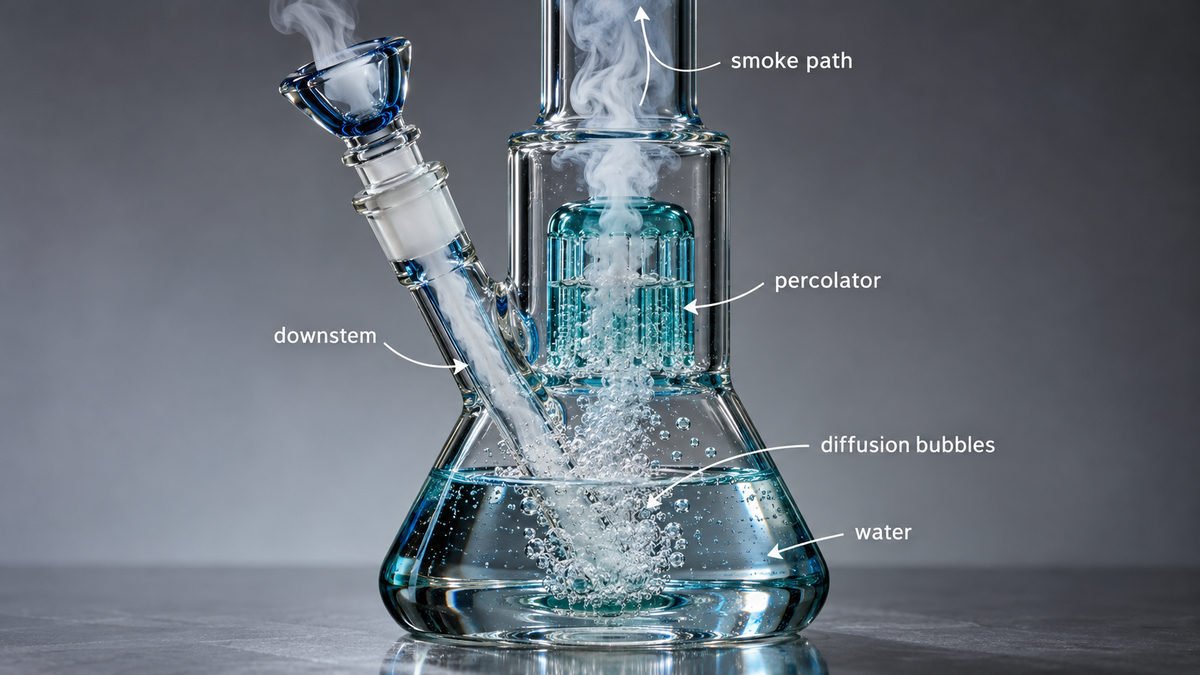
A glass bong percolator is an internal glass chamber or structure that breaks smoke into smaller bubbles. It sits inside the bong and works with water to increase diffusion before smoke reaches the mouthpiece. See where the perc sits in the anatomy of a glass water pipe.
When you light the bowl, smoke travels through the downstem and enters the water chamber. From there, it reaches the percolator, which redirects smoke through small holes, slits, jets, or openings. Finally, the dispersed smoke moves through the upper chamber and into the mouthpiece.
In simple terms, the percolator creates a larger contact area between smoke and water. One large smoke pocket has limited water contact. Hundreds of smaller bubbles expose more smoke to the surrounding water during the same draw.
Diffusion, filtration, and cooling
These three effects often overlap, but they are not identical. Diffusion disperses smoke into smaller bubbles, while filtration allows water to trap some particulate matter. Cooling reduces the temperature of the smoke as it travels through the water and glass.
However, water does not remove every irritant or harmful compound. Smoke still contains fine particles, gases, and combustion by-products after passing through a percolator. Therefore, a smoother-feeling draw does not mean safer inhalation.
Percolator performance depends on surface area, bubble size, water depth, draw speed, and chamber geometry. For example, a honeycomb design may create extremely fine bubbles, while an inline design may provide more open airflow.
Why smaller bubbles can feel smoother
Small bubbles generally expose more smoke to water than a few large bubbles. They also create more turbulence, which can spread smoke through the chamber and reduce hot, concentrated streams.
Nevertheless, more diffusion does not always create a better experience. Dense bubbling can increase drag, mute delicate flavour notes, and make the bong harder to clean. The best result usually comes from balanced diffusion and predictable airflow.
Percolators cannot reliably remove all harmful compounds, irritants, or health risks associated with inhaling smoke. For broader information about smoke exposure and respiratory risks, consult Healthdirect’s cannabis health information.
How Bubbles Affect Smoke Cooling, Filtration, and Airflow
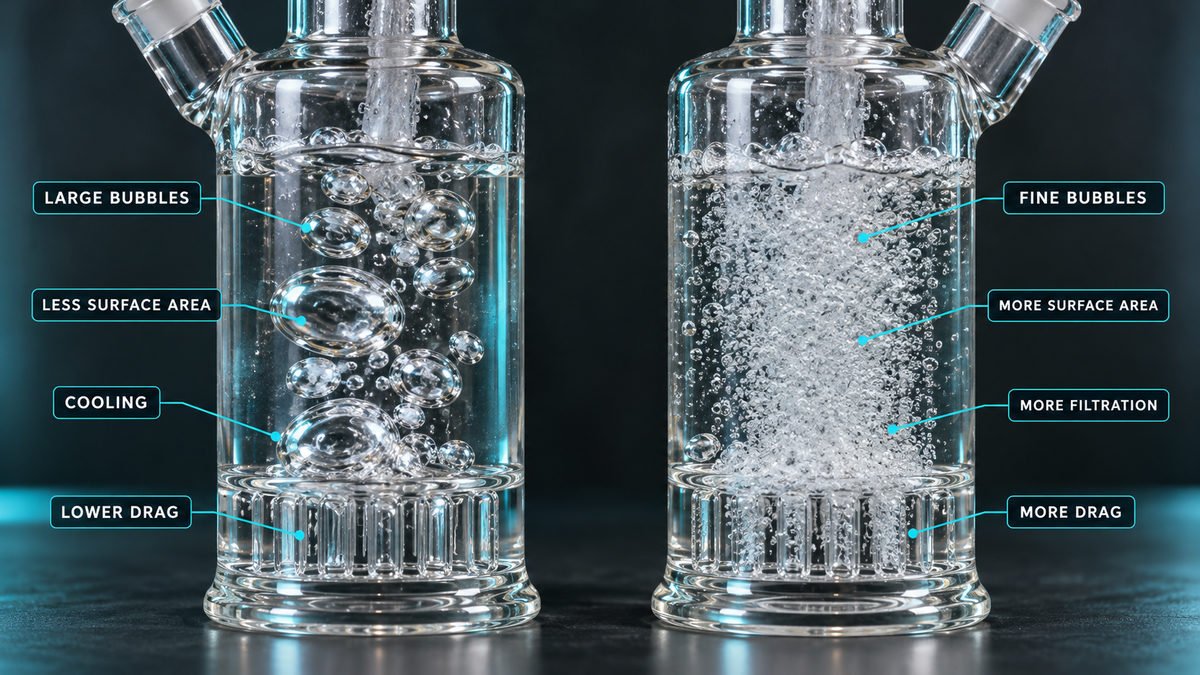
Bubble size strongly influences how a percolator feels during a draw. Smaller bubbles provide more smoke-to-water contact, while larger bubbles usually allow air to move with less resistance.
Additionally, bubble density affects turbulence inside the chamber. A dense cloud of fine bubbles may feel cooler, but it often requires stronger inhalation. A more open design can feel quicker and airier, even with less visible bubbling.
Water volume also matters. More water may provide additional cooling and filtration, but excessive water can restrict airflow. Meanwhile, the chamber’s width and height determine how long smoke remains in contact with water.
What water filtration can and cannot do
Water can trap some ash, resin droplets, and larger particulate matter. However, many gases and fine particles remain in the inhaled aerosol. Water filtration therefore changes the character of smoke without making it harmless.
Cooling can reduce the sharp sensation caused by hot smoke. However, a cooler draw may encourage deeper inhalation or larger hits. Responsible adults should remember that comfort does not remove the risks linked with smoke exposure.
Balancing diffusion with airflow
Each percolator creates resistance as smoke passes through openings and water. Smaller holes, denser chambers, and multiple diffusion stages generally increase drag.
For instance, a single showerhead may provide strong bubbling without excessive complexity. In contrast, a matrix combined with a second percolator can create substantial resistance and cleaning work.
More bubbling also increases the chance of splashback. Fast draws can pull water into the upper chamber, especially when the water level sits too high. Therefore, the most active bubbling does not always deliver the best overall performance.
Many users prefer a practical balance between:
- Cooling and perceived smoothness.
- Open, comfortable airflow.
- Flavour preservation.
- Low splashback risk.
- Simple cleaning and water changes.
Types of Bong Percolators and Their Performance Characteristics

Percolator designs use different opening patterns and chamber shapes. Consequently, two bongs with similar sizes may produce very different airflow and bubbling behaviour.
| Percolator design | Typical strengths | Common trade-offs |
|---|---|---|
| Showerhead | Strong bubbling, compact structure, straightforward maintenance | Can create moderate drag |
| Honeycomb | Fine bubbles and high diffusion | Small openings can clog easily |
| Tree | Several branching diffusion paths | More drag and difficult cleaning |
| Inline | Directional airflow and flexible chamber compatibility | Slits need regular rinsing |
| Turbine | Spinning water movement and active diffusion | Performance depends heavily on water level |
| Matrix | Dense bubbling and substantial diffusion | High maintenance and possible resistance |
Showerhead and honeycomb percolators
A showerhead percolator uses a vertical tube with openings or slits near its lower section. Smoke enters the tube and spreads through the openings, creating strong bubbling in a relatively compact footprint.
Moreover, showerhead designs often offer reasonable cleaning access. Their wider channels usually resist clogging better than extremely fine openings, although resin can still accumulate over time.
Honeycomb percolators use a flat, perforated disc. The many small holes can create fine bubbles and high diffusion potential. However, those openings can clog when dirty water, ash, or sticky residue remains inside the chamber.
Tree and inline percolators
Tree percolators contain multiple branching arms, each providing a separate diffusion path. This design can distribute smoke across several outlets and create impressive bubbling.
However, the branches add internal surfaces that collect residue. They can also increase drag, particularly when several arms sit below a deep water level. Cleaning requires patience and thorough rinsing.
Inline percolators use a horizontal tube with slits placed along its length. Smoke travels through the tube before exiting downwards or sideways, depending on the construction.
Inline designs often suit different chamber shapes and can provide directional diffusion. They may also maintain relatively open airflow when the slits remain clear.
Turbine and matrix percolators
Turbine percolators use angled jets to push water into a spinning motion. The rotating water creates visual movement and active diffusion around the chamber.
Therefore, turbine performance depends strongly on water depth and draw speed. Too little water may weaken the effect, while too much water can increase splashback.
Matrix percolators contain a dense network of small openings. They can produce abundant bubbles and substantial diffusion across a broad area.
On the other hand, matrix designs demand regular maintenance. Their dense openings can trap residue, especially when users leave old water inside the bong.
Which percolator produces the most diffusion? The name alone cannot answer that question. Construction quality, opening size, water level, airflow, chamber width, and draw technique all influence real-world performance.
Water Levels, Splashback, and Using a Percolator Bong Correctly
Start by adding water gradually through the mouthpiece or joint, depending on the bong’s design. The water should cover the percolator openings without reaching the mouthpiece during a normal draw. Water level also depends on your downstem; see bong downstem sizes explained.
Next, check that the downstem sits securely and that the bowl fits properly. Add a sensible amount of material without blocking the bowl’s airflow. Then take a gentle test inhale before lighting anything.
Finding the correct water level
The correct level produces steady bubbling across the percolator while keeping the mouthpiece clear. If the bubbles look weak or uneven, add a small amount of water and test again.
Too little water can reduce diffusion and expose the openings above the waterline. It may also create hotter smoke, uneven bubbling, and a harsher-feeling draw.
Too much water can restrict airflow and pull water into the mouthpiece. It may also create splashback, uncomfortable draws, and excess moisture around the upper chamber.
For example, a turbine may need enough water to support its spinning action. A honeycomb may work with a shallower level, depending on its internal height and construction.
Single versus multiple percolators
A single-percolator bong usually offers simpler airflow, easier cleaning, and more predictable water management. It can suit beginners and experienced users who value reliability.
Multiple percolators may increase diffusion and cooling. However, they also add drag, cleaning time, water management, and clogging points. In some designs, the second chamber adds complexity without noticeable improvement.
Beginners should prioritise stable airflow, accessible cleaning points, manageable size, and simple water-level adjustment. Additionally, thicker glass can offer better durability, although it may increase weight and cost.
Handle glass carefully and place the bong on a stable, level surface. Keep it away from hot surfaces, children, pets, and areas where it can fall. Adults should use smoking accessories responsibly and follow applicable local laws.
Percolator Bong Benefits, Limitations, and Buying Considerations
The main percolator bong benefits include smoother-feeling draws, smoke cooling, visible bubbling, and adjustable diffusion characteristics. However, those benefits come with practical compromises. Some buyers choose multi chamber bongs for stacked percolation.
- Extra diffusion can increase drag.
- Complex chambers require more frequent cleaning.
- Larger designs are less portable.
- Intricate glass structures may be more fragile.
- Heavy bubbling can change flavour and airflow.
Do percolators make bong hits healthier? No. They may cool smoke and remove some particulate matter, but they do not make inhaling smoke safe.
Percolators can reduce perceived harshness by combining diffusion and cooling. Nevertheless, draw speed, smoke temperature, water quality, material, and chamber design also affect comfort.
A regular bong usually offers simpler airflow and easier maintenance. A percolator bong adds another diffusion stage, which may improve smoothness but increase resistance and cleaning requirements.
When choosing glass bongs in Australia, consider experience level, preferred airflow, diffusion intensity, chamber size, portability, cleaning access, budget, and glass thickness. Check retailer policies, age restrictions, product quality, and applicable laws before purchasing.
You can browse Sweet Puff Australia’s product categories to compare available styles. The broader online shop may also help you assess size, construction, and accessory compatibility.
Cleaning a Glass Bong Percolator and Troubleshooting Common Problems
Change the water frequently and clean the bong before residue hardens inside small openings. Warm water can loosen fresh buildup, while isopropyl alcohol may help with suitable glass surfaces. Our cleaning guide shows how to clean the percolator and other parts.
For accessible chambers, coarse salt can provide gentle abrasion during cleaning. Rinse thoroughly afterwards, because leftover alcohol, salt, or residue should not remain inside the bong.
Percolator bongs clog because of resin buildup, dirty water, plant material, dense openings, or inadequate rinsing. Restricted airflow may also come from a blocked downstem, dirty bowl, or trapped debris.
First, check the water level and remove obvious residue. Then inspect the downstem and percolator openings with warm water. Avoid forcing sharp objects through delicate glass channels.
If bubbling becomes excessive or water reaches the mouthpiece, reduce the water slightly and slow the draw. Additionally, inspect the bong for chips, cracks, loose joints, or signs of stress.
Percolator bongs are harder to maintain when their internal structure becomes more complex. Store them securely, avoid sudden temperature changes, and handle all glass components gently.
- Confirm the water covers the openings.
- Test airflow with a gentle draw.
- Check bubbling and splashback.
- Assess cleaning access before buying.
- Choose suitable glass quality and thickness.
- Match the design to your intended frequency of use.
Conclusion
Glass bong percolators work by breaking smoke into bubbles, increasing smoke-to-water contact, and improving diffusion and cooling. The best design depends on the balance between bubble production, airflow, drag, maintenance, water level, chamber size, and experience.
Percolators can reduce perceived harshness, but they do not eliminate the health risks of inhaling smoke. Use the comparison points in this guide to choose suitable airflow, cleaning access, and diffusion.
Sweet Puff Australia brings together water pipes, glass designs, and smoking accessories for adult shoppers researching different options. Explore the Sweet Puff Australia website for current collections, product details, care guidance, and retailer policies.
Finally, follow the manufacturer’s care instructions, handle glass safely, and comply with local Australian laws.






Comment (1)
[…] A straight tube bong may create a more direct path from the bowl, through the downstem, and towards the mouthpiece. As a result, it can feel more efficient and less restricted. However, a simple downstem may provide less diffusion than a well-designed percolator. […]